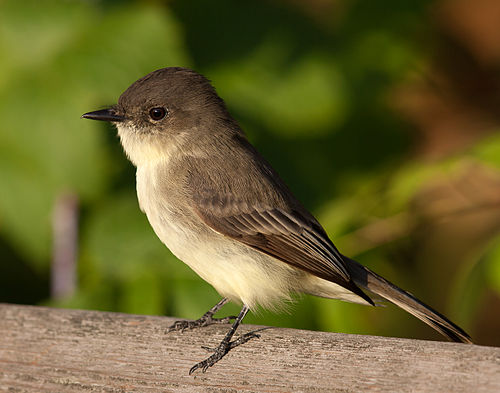



Eastern Phoebe
Sayornis phoebe
Silhouette: Emily Willoughby · PhyloPic
- KingdomAnimalia (Animals)
- PhylumChordata (Chordates)
- ClassAves (Birds)
- OrderPasseriformes (Perching Birds)
- FamilyTyrannidae (Tyrant Flycatchers)
- GenusSayornis (Phoebes)
- SpeciesSayornis phoebe (Eastern Phoebe)
About the Eastern Phoebe
The eastern phoebe (Sayornis phoebe) is a small passerine bird. The genus name Sayornis is constructed from the specific part of Charles Lucien Bonaparte's name for Say's phoebe, Muscicapa saya, and Ancient Greek ornis, "bird". Phoebe is an alternative name for the Roman moon goddess Diana, but it may also have been chosen to imitate the bird's call.
Measurements: Length: 5.5–6.7 in (14–17 cm) Weight: 0.6–0.7 oz (16–21 g) Wingspan: 10.2–11.0 in (26–28 cm) This species appears remarkably big-headed, especially if it puffs up the small crest. Its plumage is gray-brown above. It has a white throat, dirty gray breast, and buffish underparts which become whiter during the breeding season. Two indistinct buff bars are present on each wing. Its all-dark bill and lack of an eye ring and wingbars distinguish it from other North American tyrant flycatchers, and it pumps its tail up and down like other phoebes when perching on a branch. The eastern phoebe's call is a sharp chip, and the song, from which it may get its name, is fee-bee.
The eastern wood pewee (Contopus virens) is extremely similar in appearance. It lacks the buff hue usually present on the lighter parts of the... Wikipedia →
Recent sightings of Eastern Phoebe in Arrecifes de Cozumel National Park
LIVEiNaturalistClosest Relatives at Arrecifes de Cozumel National Park

 Tropical Kingbird
Tyrannus melancholicus

 Great Kiskadee
Pitangus sulphuratus

 Caribbean Elaenia
Elaenia martinica

Yellow-bellied Elaenia
Elaenia flavogaster

 Brown-crested Flycatcher
Myiarchus tyrannulus

Couch's Kingbird
Tyrannus couchii

 Northern Beardless-Tyrannulet
Camptostoma imberbe

 Eastern Wood-Pewee
Contopus virens

Dusky-capped Flycatcher
Myiarchus tuberculifer

Least Flycatcher
Empidonax minimus

Boat-billed Flycatcher
Megarynchus pitangua

Social Flycatcher
Myiozetetes similis
Global Distribution
Warmer areas are where this animal is recorded most often.
Parks Where Found
| # | Park | Country | Daily sighting probability |
|---|---|---|---|
| 1 | Congaree National Park | 🇺🇸 United States | |
| 2 | Big Cypress National Preserve | 🇺🇸 United States | |
| 3 | Shenandoah National Park | 🇺🇸 United States | |
| 4 | Everglades National Park | 🇺🇸 United States | |
| 5 | Acadia National Park | 🇺🇸 United States | |
| 6 | Wood Buffalo National Park | 🇨🇦 Canada | |
| 7 | Point Pelee National Park | 🇨🇦 Canada | |
| 8 | Isle Royale National Park | 🇺🇸 United States | |
| 9 | Arrecifes de Cozumel National Park | 🇲🇽 Mexico | |
| 10 | Celestún Biosphere Reserve | 🇲🇽 Mexico | |
| 11 | Saguaro National Park | 🇺🇸 United States | |
| 12 | Joshua Tree National Park | 🇺🇸 United States | |
| 13 | Cape Breton Highlands National Park | 🇨🇦 Canada | |
| 14 | Ría Lagartos Biosphere Reserve | 🇲🇽 Mexico | |
| 15 | El Vizcaíno Biosphere Reserve | 🇲🇽 Mexico |
Quick answers
What are the chances of seeing a Eastern Phoebe in Arrecifes de Cozumel National Park?
Under 5% of wildlife watchers report a Eastern Phoebe sighting in Arrecifes de Cozumel National Park, based on 40 verified sightings from GBIF citizen-science data.
When is the best time to see Eastern Phoebe in Arrecifes de Cozumel National Park?
February has the highest sighting rate for Eastern Phoebe in Arrecifes de Cozumel National Park in our monthly data.