


Greater Long-tongued Fruit Bat
Macroglossus sobrinus
Silhouette: John Curtis (vectorized by T. Michael Keesey) · PhyloPic
- KingdomAnimalia (Animals)
- PhylumChordata (Chordates)
- ClassMammalia (Mammals)
- OrderChiroptera (Bats)
- FamilyPteropodidae (Old World Fruit Bats)
- GenusMacroglossus (Long-tongued Fruit Bats)
- SpeciesMacroglossus sobrinus (Greater Long-tongued Fruit Bat)
About the Greater Long-tongued Fruit Bat
The long-tongued fruit bat (Macroglossus sobrinus) is a species of megabat. It is nectarivorous, feeding on nectar from primarily banana flowers. It is found in several countries in South and Southeast Asia. It was described as a new subspecies in 1911 by Danish mammalogist Knud Andersen. Andersen described it as a subspecies of the long-tongued nectar bat, with the trinomen Macroglossus minimus sobrinus.
Beginning in approximately 1983, it has been considered a full species rather than a subspecies. Its species name "sobrinus" means "cousin;" Andersen possibly chose this name to reflect what he believed was its close relationship to M. minimus minimus.
Andersen noted that it differed from the long-tongued nectar bat in several ways. Overall, it is a larger species with a longer snout. Its forearm is 42–48.5 mm (1.65–1.91 in) long and individuals weigh 18–26 g (0.63–0.92 oz).
The long-tongued fruit bat feeds on nectar almost exclusively from banana flowers. It is nocturnal, foraging at night and roosting during the day in trees. It roosts singly or in small, "well-spaced parties." Unlike... Wikipedia →
Recent sightings of Greater Long-tongued Fruit Bat in Cuc Phuong National Park
LIVEiNaturalistClosest Relatives at Cuc Phuong National Park

 Greater Short-nosed Fruit Bat
Cynopterus sphinx

 Exotic Leaf-nosed Bat
Hipposideros gentilis

intermediate roundleaf bat
Hipposideros larvatus

Great Roundleaf Bat
Hipposideros armiger

Lesser false vampire bat
Megaderma spasma
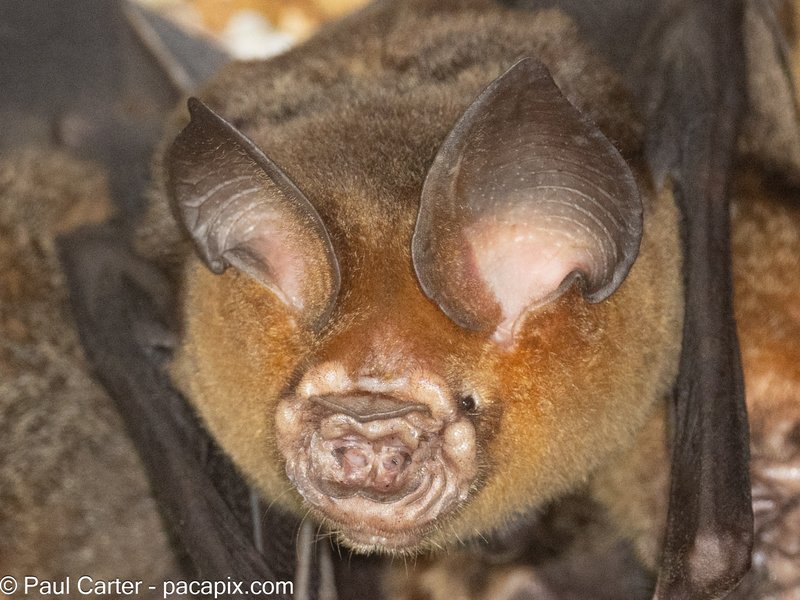
Ha Long Roundleaf Bat
Hipposideros alongensis

Stoliczka's Trident Bat
Aselliscus stoliczkanus

 Great Evening Bat
Ia io

 Pearson's Horseshoe Bat
Rhinolophus pearsonii
Global Distribution
Warmer areas are where this animal is recorded most often.
Parks Where Found
| # | Park | Country | Daily sighting probability |
|---|---|---|---|
| 1 | Cuc Phuong National Park | 🇻🇳 Vietnam | |
| 2 | Khao Sok National Park | 🇹🇭 Thailand |