

Great Roundleaf Bat
Hipposideros armiger
Silhouette: T. Michael Keesey · PhyloPic
- KingdomAnimalia (Animals)
- PhylumChordata (Chordates)
- ClassMammalia (Mammals)
- OrderChiroptera (Bats)
- FamilyHipposideridae (Old World Leaf-nosed Bats)
- GenusHipposideros (Old World Roundleaf Bats)
- SpeciesHipposideros armiger (Great Roundleaf Bat)
About the Great Roundleaf Bat
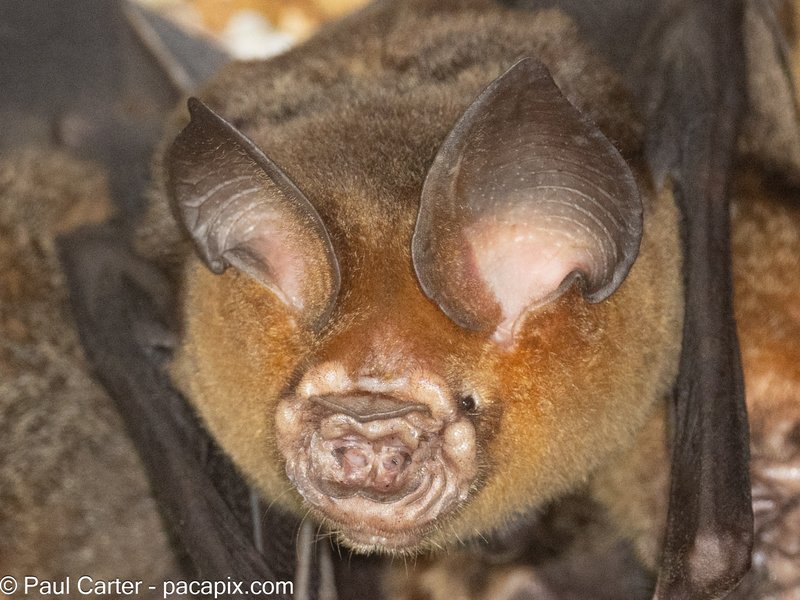
The great roundleaf bat, also known as the great Himalayan leaf-nosed bat (Hipposideros armiger) is a species of bat in the family Hipposideridae found in South Asia, Southeast Asia, and China. It gives birth to two young a year. It has been assessed as a least concern species by the IUCN.
There are four recognised subspecies of the bat. They are: H. a. armiger H. a. fujianensis H. a. terasensis H. a. traninhensis The great roundleaf bat is similar in appearance to the closely related intermediate roundleaf bat (H. larvatus). However, the great roundleaf bat is larger and possesses four, not three, lateral accessory leaflets on each side of the main noseleaf. This bat has a forearm length up to 9.8 cm, and weighs up to 60 g. After an experiment published by Kathryn Knight, in which they painted the accessory leaflets and the ears and videotaped them, it was concluded that when they clicked, the leaflets closed and their ears bent down. When listening to the clicking they opened their noseleaf and their ears.
It breeds once a year and gives birth to two young. Females have been found pregnant from January to early May... Wikipedia →
Recent sightings of Great Roundleaf Bat in Cuc Phuong National Park
LIVEiNaturalistClosest Relatives at Cuc Phuong National Park

 Exotic Leaf-nosed Bat
Hipposideros gentilis

intermediate roundleaf bat
Hipposideros larvatus
Ha Long Roundleaf Bat
Hipposideros alongensis

Stoliczka's Trident Bat
Aselliscus stoliczkanus

 Greater Long-tongued Fruit Bat
Macroglossus sobrinus

Lesser false vampire bat
Megaderma spasma

 Greater Short-nosed Fruit Bat
Cynopterus sphinx

 Great Evening Bat
Ia io

 Pearson's Horseshoe Bat
Rhinolophus pearsonii
Global Distribution
Warmer areas are where this animal is recorded most often.
Parks Where Found
| # | Park | Country | Daily sighting probability |
|---|---|---|---|
| 1 | Taroko National Park | 🇹🇼 Taiwan | |
| 2 | Khao Yai National Park | 🇹🇭 Thailand | |
| 3 | Cuc Phuong National Park | 🇻🇳 Vietnam | |
| 4 | Khao Sok National Park | 🇹🇭 Thailand | |
| 5 | Khao Luang National Park | 🇹🇭 Thailand | |
| 6 | Kaeng Krachan National Park | 🇹🇭 Thailand |