



Lesser false vampire bat
Megaderma spasma
Silhouette: T. Michael Keesey · PhyloPic
- KingdomAnimalia (Animals)
- PhylumChordata (Chordates)
- ClassMammalia (Mammals)
- OrderChiroptera (Bats)
- FamilyMegadermatidae (False Vampire Bats)
- GenusMegaderma
- SpeciesMegaderma spasma (Lesser false vampire bat)
About the Lesser false vampire bat
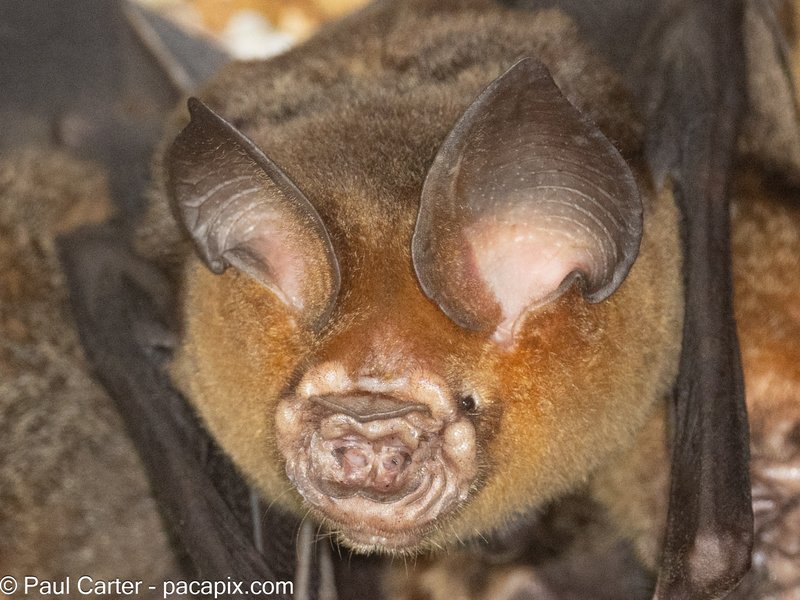
The lesser false vampire bat (Megaderma spasma) is a bat found in South Asia and Southeast Asia from Sri Lanka and India in the west to Indonesia and the Philippines in the east. They live in caves and tree hollows. They are insectivorous.
The lesser false vampire bat has a wingspan of up to 30 centimetres (12 in) and have a head-and-body length of around 10 centimetres (3.9 in). Their forearms are normally around 7 centimetres (2.8 in). The lesser false vampire bat has yellowish veins through the wing, and when the wings are spread with light behind, they are given a prominent yellow/orange tinge. Their body colour ranges from grey-brown to blue-brown. Lesser false vampire bats live in rock crevices, caves, foliage and hollow trees, depending on availability, as well as hanging and sleeping on trees in general.
M. spasma has fur pale grey to grey-brown in colour. Its noseleaf has long dorsal lobe with stiffened central ridge and broad convex flaps on the sides. Its ears are very large, joined at the base and it has no visible tail. Its echolocation pulses are short, low in density and broadband and its large ears are sensitive to echoes returning from their pulses... Wikipedia →
Recent sightings of Lesser false vampire bat in Cuc Phuong National Park
LIVEiNaturalistClosest Relatives at Cuc Phuong National Park

 Exotic Leaf-nosed Bat
Hipposideros gentilis

intermediate roundleaf bat
Hipposideros larvatus

 Greater Long-tongued Fruit Bat
Macroglossus sobrinus

Great Roundleaf Bat
Hipposideros armiger
Ha Long Roundleaf Bat
Hipposideros alongensis

Stoliczka's Trident Bat
Aselliscus stoliczkanus

 Greater Short-nosed Fruit Bat
Cynopterus sphinx

 Great Evening Bat
Ia io

 Pearson's Horseshoe Bat
Rhinolophus pearsonii
Global Distribution
Warmer areas are where this animal is recorded most often.
Parks Where Found
| # | Park | Country | Daily sighting probability |
|---|---|---|---|
| 1 | Way Kambas National Park | 🇮🇩 Indonesia | |
| 2 | Tanjung Puting National Park | 🇮🇩 Indonesia | |
| 3 | Tangkoko Nature Reserve | 🇮🇩 Indonesia | |
| 4 | Cat Tien National Park | 🇻🇳 Vietnam | |
| 5 | Khao Yai National Park | 🇹🇭 Thailand | |
| 6 | Kaeng Krachan National Park | 🇹🇭 Thailand | |
| 7 | Cuc Phuong National Park | 🇻🇳 Vietnam | |
| 8 | Gunung Leuser National Park | 🇮🇩 Indonesia | |
| 9 | Bako National Park | 🇲🇾 Malaysia | |
| 10 | Sinharaja Forest Reserve | 🇱🇰 Sri Lanka | |
| 11 | Kinabalu Park | 🇲🇾 Malaysia | |
| 12 | Khao Sok National Park | 🇹🇭 Thailand |