
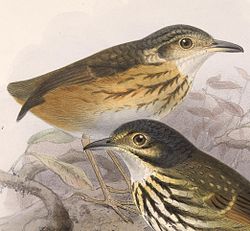

Thicket Antpitta
Hylopezus dives
Silhouette: Edwin Price · PhyloPic
- KingdomAnimalia (Animals)
- PhylumChordata (Chordates)
- ClassAves (Birds)
- OrderPasseriformes (Perching Birds)
- FamilyGrallariidae (Antpittas)
- GenusHylopezus (Streak-breasted Antpittas)
- SpeciesHylopezus dives (Thicket Antpitta)
About the Thicket Antpitta
The thicket antpitta (Myrmothera dives) is a species of bird in the family Grallariidae. It is found in Colombia, Costa Rica, Honduras, Nicaragua, and Panama. The thicket antpitta was originally described in 1865 as Grallaria dives. It was later transferred to genus Hylopezus and still later to Myrmothera. The thicket antpitta was long considered a subspecies of the white-lored antpitta (M. fulviventris); the combined species was called the "fulvous-bellied antpitta".
The thicket antpitta has three subspecies, the nominate M. d. dives (Salvin, 1865), M. d. flammulatus (Griscom, 1928), and M. d. barbacoae (Chapman, 1914). The thicket antpitta is 13 to 16.5 cm (5.1 to 6.5 in) long; four individuals weighed between 38 and 44 g (1.3 and 1.6 oz). The sexes have the same plumage. Adults of the nominate subspecies have a buff loral patch and buff around their eye. Their crown, nape, and ear coverts are dull slate gray. Their upperparts are dull slate gray that becomes olive by the rump; their back has faint pale buffy streaks. Their uppertail coverts and tail are russet brown. Their wings are mostly dark olive-brown with paler rufescent brown... Wikipedia →
Recent sightings of Thicket Antpitta in Farallones de Cali National Natural Park
LIVEiNaturalistClosest Relatives at Farallones de Cali National Natural Park

 Streak-chested Antpitta
Hylopezus perspicillatus

Scaled Antpitta
Grallaria guatimalensis

Plain-backed Antpitta
Grallaria haplonota

Chestnut-crowned Antpitta
Grallaria ruficapilla

Slate-crowned Antpitta
Grallaricula nana

Yellow-breasted Antpitta
Grallaria flavotincta

Undulated Antpitta
Grallaria squamigera

Ochre-breasted Antpitta
Grallaricula flavirostris

 Golden Tanager
Tangara arthus

Flame-rumped Tanager
Ramphocelus flammigerus

 Black-billed Thrush
Turdus ignobilis

Green Honeycreeper
Chlorophanes spiza
Global Distribution
Warmer areas are where this animal is recorded most often.
Parks Where Found
| # | Park | Country | Daily sighting probability |
|---|---|---|---|
| 1 | Arenal Volcano National Park | 🇨🇷 Costa Rica | |
| 2 | Tapantí-Macizo de la Muerte National Park | 🇨🇷 Costa Rica | |
| 3 | Tenorio Volcano National Park | 🇨🇷 Costa Rica | |
| 4 | Braulio Carrillo National Park | 🇨🇷 Costa Rica | |
| 5 | Farallones de Cali National Natural Park | 🇨🇴 Colombia | |
| 6 | Darién National Park | 🇵🇦 Panama | |
| 7 | La Amistad International Park (Panama) | 🇵🇦 Panama | |
| 8 | Utría National Natural Park | 🇨🇴 Colombia | |
| 9 | Cahuita National Park | 🇨🇷 Costa Rica | |
| 10 | Gandoca-Manzanillo Wildlife Refuge | 🇨🇷 Costa Rica | |
| 11 | Bastimentos Island National Marine Park | 🇵🇦 Panama | |
| 12 | Monteverde Cloud Forest Reserve | 🇨🇷 Costa Rica |
Quick answers
What are the chances of seeing a Thicket Antpitta in Farallones de Cali National Natural Park?
Under 5% of wildlife watchers report a Thicket Antpitta sighting in Farallones de Cali National Natural Park, based on 83 verified sightings from GBIF citizen-science data.
When is the best time to see Thicket Antpitta in Farallones de Cali National Natural Park?
June has the highest sighting rate for Thicket Antpitta in Farallones de Cali National Natural Park in our monthly data.