

Great Gerbil
Rhombomys opimus
Silhouette: T. Michael Keesey · PhyloPic
- KingdomAnimalia (Animals)
- PhylumChordata (Chordates)
- ClassMammalia (Mammals)
- OrderRodentia (Rodents)
- FamilyMuridae (Old World Mice and Rats)
- GenusRhombomys
- SpeciesRhombomys opimus (Great Gerbil)
About the Great Gerbil
The great gerbil (Rhombomys opimus) is a large rodent found throughout much of Central Asia. The largest of the gerbils, great gerbils have a head and body length of 15–20 cm (6–8 in). Their skulls are distinctive by having two grooves in each incisor. They have large front claws used for burrowing.
Great gerbils are found in arid habitats, predominantly in sandy or clay deserts. They are found in Turkmenistan, Kazakhstan, Mongolia, China, Pakistan, Afghanistan, and Iran. The great gerbil is preyed on by foxes, owls, kites, wildcats, weasels, vultures, and cobras.
Great gerbils live in family groups and occupy one burrow per family. Their burrows can be fairly extensive with separate chambers for nests and food storage. Great gerbils spend considerably more time in the burrows during winter, but do not hibernate. They are predominantly diurnal. Food consists mostly of vegetable matter.
The animals are often colonial. Longevity is 2–4 years. Burrow system complexes have a distinctive region of cleared soil and can be seen and mapped from aerial photos and satellite images. Inhabited great gerbil... Wikipedia →
Recent sightings of Great Gerbil in Gobi Gurvansaikhan National Park
LIVEiNaturalistClosest Relatives at Gobi Gurvansaikhan National Park

 Mongolian Jird
Meriones unguiculatus

 Mid-day Jird
Meriones meridianus

 Alashan Ground Squirrel
Spermophilus alashanicus

 Siberian Jerboa
Allactaga sibirica

 Desert Hamster
Phodopus roborovskii

 Hairy-footed Jerboa
Dipus sagitta

 Tarbagan Marmot
Marmota sibirica

Pallid Ground Squirrel
Spermophilus pallidicauda

Mongolian Hamster
Allocricetulus curtatus
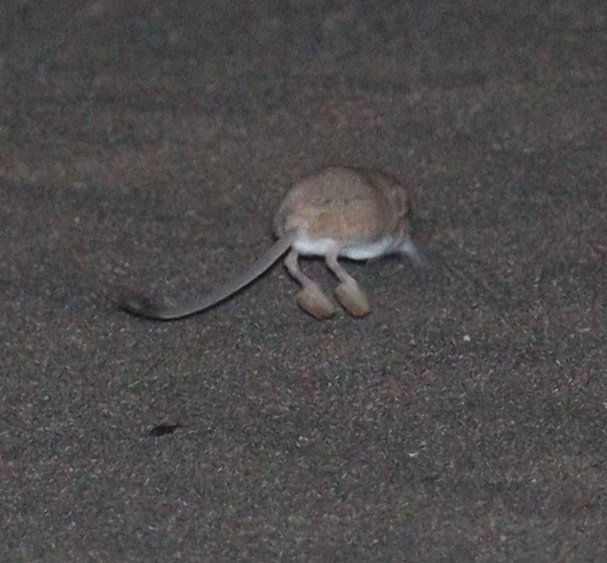
Andrews's Three-toed Jerboa
Stylodipus andrewsi

Thick-tailed Pygmy Jerboa
Salpingotus crassicauda
Global Distribution
Warmer areas are where this animal is recorded most often.
Parks Where Found
| # | Park | Country | Daily sighting probability |
|---|---|---|---|
| 1 | Gobi Gurvansaikhan National Park | 🇲🇳 Mongolia |
More parks will be added in future updates.