

Thick-tailed Pygmy Jerboa
Salpingotus crassicauda
Silhouette: T. Michael Keesey · PhyloPic
- KingdomAnimalia (Animals)
- PhylumChordata (Chordates)
- ClassMammalia (Mammals)
- OrderRodentia (Rodents)
- FamilyDipodidae (Jerboas)
- GenusSalpingotus (Three-toed Pygmy Jerboas)
- SpeciesSalpingotus crassicauda (Thick-tailed Pygmy Jerboa)
About the Thick-tailed Pygmy Jerboa
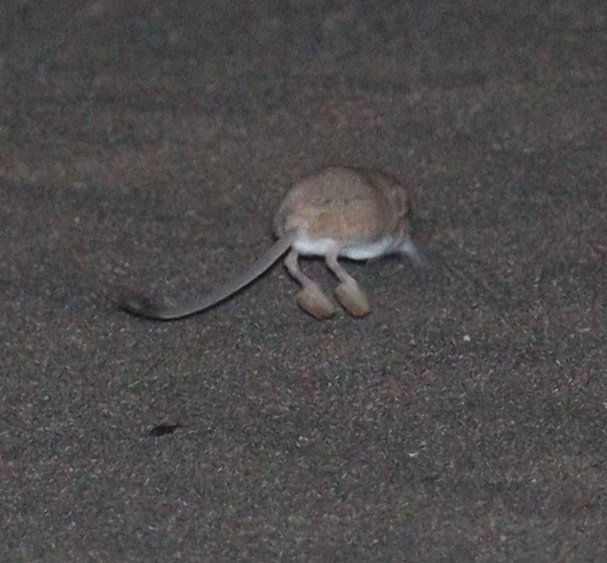
The thick-tailed pygmy jerboa (Salpingotus crassicauda) is a species of rodent in the family Dipodidae. It is found in China, Kazakhstan, and Mongolia. Its natural habitats are temperate grassland and temperate desert. It is threatened by habitat loss. It is listed by the IUCN as being "least concern".
This species grows to a head-and-body length of around 45 to 60 mm (1.8 to 2.4 in) with a slightly longer tail. The head is large and the eyes small, the ears are short and tubular and the tail may have a thickening near the base where fat is deposited. These jerboas get most of their water intake from the food that they consume; however, they will drink water if they can find it.
The thick-tailed pygmy jerboa is a solitary nocturnal animal. It has a permanent burrow with many passages which may extend for 3 m (10 ft). The entrances are sealed with loose plugs of sand and if the jerboa is spotted in the open by a predator it attempts to bury itself in the sand. Predators include owls, mountain weasels (Mustela altaica), marbled polecats (Vormela peregusna) and red foxes (Vulpes vulpes). This jerboa feeds on small invertebrates such as grasshoppers and... Wikipedia →
Recent sightings of Thick-tailed Pygmy Jerboa in Gobi Gurvansaikhan National Park
LIVEiNaturalistClosest Relatives at Gobi Gurvansaikhan National Park

 Siberian Jerboa
Allactaga sibirica

 Hairy-footed Jerboa
Dipus sagitta
 Andrews's Three-toed Jerboa
Stylodipus andrewsi

 Mongolian Jird
Meriones unguiculatus

 Alashan Ground Squirrel
Spermophilus alashanicus

Desert Hamster
Phodopus roborovskii

 Tarbagan Marmot
Marmota sibirica

 Mid-day Jird
Meriones meridianus

Great Gerbil
Rhombomys opimus

Pallid Ground Squirrel
Spermophilus pallidicauda

Mongolian Hamster
Allocricetulus curtatus
Global Distribution
Warmer areas are where this animal is recorded most often.
Parks Where Found
| # | Park | Country | Daily sighting probability |
|---|---|---|---|
| 1 | Gobi Gurvansaikhan National Park | 🇲🇳 Mongolia |
More parks will be added in future updates.