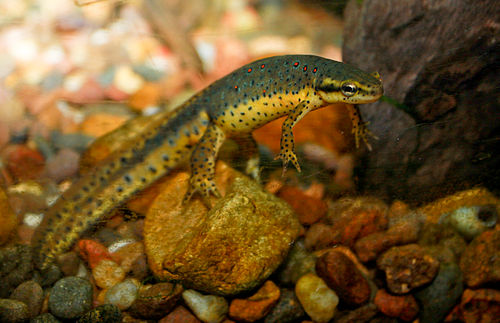



Eastern Newt
Notophthalmus viridescens
Silhouette: Beth Reinke · PhyloPic
- KingdomAnimalia (Animals)
- PhylumChordata (Chordates)
- ClassAmphibia (Amphibians)
- OrderCaudata (Salamanders)
- FamilySalamandridae (True Salamanders and Newts)
- GenusNotophthalmus (Eastern North American Newts)
- SpeciesNotophthalmus viridescens (Eastern Newt)
About the Eastern Newt
The eastern newt (Notophthalmus viridescens) is a common newt of eastern North America. It frequents small lakes, ponds, vernal ponds and streams or nearby wooded areas. The eastern newt produces tetrodotoxin, which makes the species unpalatable to predatory fish and crayfish. It has a lifespan of 12 to 15 years in the wild, and it may grow to 5 in (13 cm) in length. These animals are common aquarium pets, being either collected from the wild or sold commercially. The striking bright orange juvenile stage, which is land-dwelling, is known as a red eft. Some sources blend the general name of the species and that of the red-spotted newt subspecies into the eastern red-spotted newt (although there is no "western" one).
The eastern newt includes these four subspecies: Red-spotted newt (Notophthalmus viridescens viridescens); Broken-striped newt (Notophthalmus viridescens dorsalis); Central newt (Notophthalmus viridescens louisianensis) - Central newts measure from 2.5 in (6.4 cm) to 4 in (10 cm) in length. They are brown or green, with fine black dots all over the body. There may be a row of red spots on each side of the body. The belly is yellow or orange and is noticeably... Wikipedia →
Recent sightings of Eastern Newt in Great Smoky Mountains National Park
LIVEiNaturalistClosest Relatives at Great Smoky Mountains National Park

 Blue Ridge Two-lined Salamander
Eurycea wilderae

 Red-cheeked Salamander
Plethodon jordani

 Spring Salamander
Gyrinophilus porphyriticus

 Seal Salamander
Desmognathus monticola

Imitator Salamander
Desmognathus imitator

Southern Red-backed Salamander
Plethodon serratus

 Red Salamander
Pseudotriton ruber

Pygmy Salamander
Desmognathus wrighti
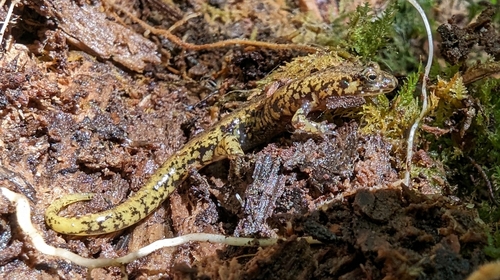
Cherokee Mountain Dusky Salamander
Desmognathus adatsihi

Northern Slimy Salamander
Plethodon glutinosus

Southern Gray-cheeked Salamander
Plethodon metcalfi

Santeetlah Dusky Salamander
Desmognathus santeetlah
Global Distribution
Warmer areas are where this animal is recorded most often.
Parks Where Found
| # | Park | Country | Daily sighting probability |
|---|---|---|---|
| 1 | Shenandoah National Park | 🇺🇸 United States | |
| 2 | Acadia National Park | 🇺🇸 United States | |
| 3 | Cape Breton Highlands National Park | 🇨🇦 Canada | |
| 4 | Point Pelee National Park | 🇨🇦 Canada | |
| 5 | Big Cypress National Preserve | 🇺🇸 United States | |
| 6 | Isle Royale National Park | 🇺🇸 United States | |
| 7 | Everglades National Park | 🇺🇸 United States |
Quick answers
What are the chances of seeing a Eastern Newt in Great Smoky Mountains National Park?
About 30% of wildlife watchers report a Eastern Newt sighting in Great Smoky Mountains National Park, based on 167 verified sightings from GBIF citizen-science data.
When is the best time to see Eastern Newt in Great Smoky Mountains National Park?
May has the highest sighting rate for Eastern Newt in Great Smoky Mountains National Park in our monthly data.