

Blyth's Pipit
Anthus godlewskii
Silhouette: Susan Murphy (original photograph), T. Michael Keesey (vectorization) · PhyloPic
- KingdomAnimalia (Animals)
- PhylumChordata (Chordates)
- ClassAves (Birds)
- OrderPasseriformes (Perching Birds)
- FamilyMotacillidae (Wagtails and Pipits)
- GenusAnthus (Pipits)
- SpeciesAnthus godlewskii (Blyth's Pipit)
About the Blyth's Pipit
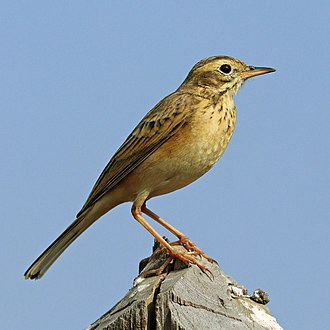
Blyth's pipit (Anthus godlewskii) is a medium-sized passerine bird which breeds in Mongolia and neighbouring areas of China, Tibet and India. It is a long distance migrant moving to open lowlands in Southern Asia. It is a very rare vagrant to western Europe.
This is a large pipit, but is an undistinguished looking species on the ground, mainly brown above and pale below. It is very similar to Richard's pipit, but is slightly smaller, shorter legs and a shorter dark bill. Its flight is strong and direct, and it gives a characteristic "pshee" call, higher pitched than Richard's.
In south Asia, in winter some care must be taken to distinguish this from other large pipits which winter or are resident in the area, including Richard's. This species is insectivorous. This bird was named after the English zoologist Edward Blyth. The genus name Anthus is the Latin name for a small bird of grasslands. The specific godlewskii commemorates Polish nobleman and field naturalist Victor Godlewski.
Heard, Chris (1995) Unravelling the mystery Birdwatch 41:20-24 Page, Doug (1997) From the Rarities Committee's files: problems presented... Wikipedia →
Recent sightings of Blyth's Pipit in Horton Plains National Park
LIVEiNaturalistClosest Relatives at Horton Plains National Park
 Oriental Pipit
Anthus rufulus

 Richard's Pipit
Anthus richardi

 Grey Wagtail
Motacilla cinerea

 Forest Wagtail
Dendronanthus indicus

White Wagtail
Motacilla alba

Citrine Wagtail
Motacilla citreola

 Sri Lanka White-eye
Zosterops ceylonensis

 Pied Bushchat
Saxicola caprata

 Yellow-eared Bulbul
Pycnonotus penicillatus

 Hill Swallow
Hirundo domicola

 Dull-blue Flycatcher
Eumyias sordidus

 Large-billed Crow
Corvus macrorhynchos
Global Distribution
Warmer areas are where this animal is recorded most often.
Parks Where Found
| # | Park | Country | Daily sighting probability |
|---|---|---|---|
| 1 | Gobi Gurvansaikhan National Park | 🇲🇳 Mongolia | |
| 2 | Bandhavgarh National Park | 🇮🇳 India | |
| 3 | Horton Plains National Park | 🇱🇰 Sri Lanka | |
| 4 | Yala National Park | 🇱🇰 Sri Lanka | |
| 5 | Manas National Park | 🇮🇳 India | |
| 6 | Kaziranga National Park | 🇮🇳 India | |
| 7 | Kanha National Park | 🇮🇳 India | |
| 8 | Wadden Sea National Park | 🇩🇪 Germany | |
| 9 | Chitwan National Park | 🇳🇵 Nepal | |
| 10 | Jiuzhaigou National Park | 🇨🇳 China | |
| 11 | Satpura National Park | 🇮🇳 India | |
| 12 | Royal Bardia National Park | 🇳🇵 Nepal | |
| 13 | Mudumalai National Park | 🇮🇳 India | |
| 14 | Royal Manas National Park | 🇧🇹 Bhutan | |
| 15 | Wilpattu National Park | 🇱🇰 Sri Lanka |
Quick answers
What are the chances of seeing a Blyth's Pipit in Horton Plains National Park?
Under 5% of wildlife watchers report a Blyth's Pipit sighting in Horton Plains National Park, based on 10 verified sightings from GBIF citizen-science data.
When is the best time to see Blyth's Pipit in Horton Plains National Park?
March has the highest sighting rate for Blyth's Pipit in Horton Plains National Park in our monthly data.