



Forest Wagtail
Dendronanthus indicus
Silhouette: Sheatherius · PhyloPic
- KingdomAnimalia (Animals)
- PhylumChordata (Chordates)
- ClassAves (Birds)
- OrderPasseriformes (Perching Birds)
- FamilyMotacillidae (Wagtails and Pipits)
- GenusDendronanthus (Forest Wagtails)
- SpeciesDendronanthus indicus (Forest Wagtail)
About the Forest Wagtail
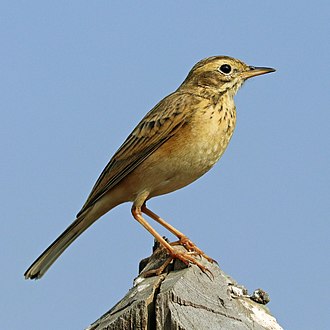
The forest wagtail (Dendronanthus indicus) is a medium-sized passerine bird in the wagtail family Motacillidae. It has a distinctive plumage that sets it apart from other wagtails and has the habit of wagging its tail sideways unlike the usual up and down movements of the other wagtail species. It is the only wagtail species that nests in trees. It is found mainly in forested habitats, breeding in the temperate parts of east Asia and wintering across tropical Asia from India to Indonesia.
The forest wagtail was formally described in 1789 by the German naturalist Johann Friedrich Gmelin in his revised and expanded edition of Carl Linnaeus's Systema Naturae. He placed it with the wagtails in the genus Motacilla and coined the binomial name Motacilla indica. The specific epithet is from Latin indicus meaning "Indian". Gmelin based his account on "La Bergeronnette gris des Indes" that had been described in 1782 by the French naturalist Pierre Sonnerat. The forest wagtail is now the only species placed in the genus Dendronanthus that was introduced in 1844 by the English zoologist Edward Blyth. The name Dendronanthus combines the Ancient Greek dendron meaning "tree" with the... Wikipedia →
Recent sightings of Forest Wagtail in Horton Plains National Park
LIVEiNaturalistClosest Relatives at Horton Plains National Park
 Oriental Pipit
Anthus rufulus

 Grey Wagtail
Motacilla cinerea

 Blyth's Pipit
Anthus godlewskii

Richard's Pipit
Anthus richardi

White Wagtail
Motacilla alba

Citrine Wagtail
Motacilla citreola

 Sri Lanka White-eye
Zosterops ceylonensis

 Pied Bushchat
Saxicola caprata

 Yellow-eared Bulbul
Pycnonotus penicillatus

 Hill Swallow
Hirundo domicola

 Dull-blue Flycatcher
Eumyias sordidus

 Large-billed Crow
Corvus macrorhynchos
Global Distribution
Warmer areas are where this animal is recorded most often.
Parks Where Found
Quick answers
What are the chances of seeing a Forest Wagtail in Horton Plains National Park?
Under 5% of wildlife watchers report a Forest Wagtail sighting in Horton Plains National Park, based on 8 verified sightings from GBIF citizen-science data.
When is the best time to see Forest Wagtail in Horton Plains National Park?
December has the highest sighting rate for Forest Wagtail in Horton Plains National Park in our monthly data.