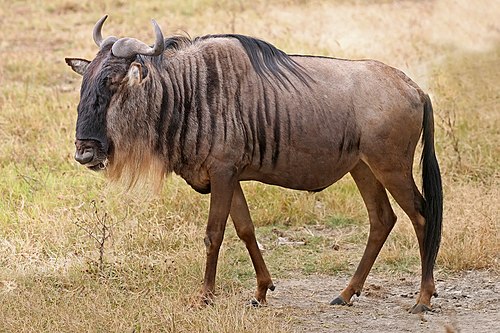


Blue Wildebeest
Connochaetes taurinus
Silhouette: [unknown] · PhyloPic
- KingdomAnimalia (Animals)
- PhylumChordata (Chordates)
- ClassMammalia (Mammals)
- OrderArtiodactyla (Even-toed Ungulates and Cetaceans)
- FamilyBovidae (Bovids)
- GenusConnochaetes (Wildebeests)
- SpeciesConnochaetes taurinus (Blue Wildebeest)
About the Blue Wildebeest
The blue wildebeest (Connochaetes taurinus), also called the common wildebeest, white-bearded gnu or brindled gnu, is a large antelope and one of the two species of wildebeest. It is placed in the genus Connochaetes and family Bovidae, and has a close taxonomic relationship with the black wildebeest. The blue wildebeest is known to have five subspecies. This broad-shouldered antelope has a muscular, front-heavy appearance, with a distinctive, robust muzzle. Young blue wildebeest are born tawny brown, and begin to take on their adult coloration at the age of 2 months. The adults' hues range from a deep slate or bluish-gray to light gray or even grayish-brown. Both sexes possess a pair of large curved horns.
The blue wildebeest is an herbivore, feeding primarily on short grasses. It forms herds which move about in loose aggregations, the animals being fast runners and extremely wary. The mating season begins at the end of the rainy season and a single calf is usually born after a gestational period of about 8.5 months. The calf remains with its mother for 8 months, after which it joins a juvenile herd. Blue wildebeest are found in short-grass plains bordering bush-covered acacia savannas in southern and eastern Africa, thriving in areas that are neither too wet nor too arid. Three African populations of blue wildebeest take part in a long-distance migration, timed to coincide with the annual pattern of rainfall and grass growth on the short-grass plains where they can find the nutrient-rich forage necessary for lactation and calf growth.
The blue wildebeest is native to Angola, Botswana, Eswatini, Kenya, Mozambique, South Africa, Tanzania, Zambia, and Zimbabwe. Today, it is extinct in Malawi, but has been successfully reintroduced in Namibia. The southern limit of the blue wildebeest range is the Orange River, while the western limit is bounded by Lake Victoria and Mount Kenya. The blue wildebeest is widespread and is being introduced into private game farms, reserves, and conservancies. The International Union for Conservation of Nature and Natural Resources rates the blue wildebeest as being of least concern. The population has been estimated to be around 1.5 million, and the population trend is stable. Wikipedia →
Recent sightings of Blue Wildebeest in Hwange National Park
LIVEiNaturalistClosest Relatives at Hwange National Park

 Greater Kudu
Tragelaphus strepsiceros

 Impala
Aepyceros melampus

Steenbok
Raphicerus campestris

 Sable Antelope
Hippotragus niger

Roan Antelope
Hippotragus equinus

 African Buffalo
Syncerus caffer

 Waterbuck
Kobus ellipsiprymnus

 Common Eland
Taurotragus oryx

 Southern Reedbuck
Redunca arundinum

Northern Bushbuck
Tragelaphus scriptus

 Bush Duiker
Sylvicapra grimmia

Tsessebe
Damaliscus lunatus
Global Distribution
Warmer areas are where this animal is recorded most often.
Parks Where Found
Quick answers
What are the chances of seeing a Blue Wildebeest in Hwange National Park?
About 40% of wildlife watchers report a Blue Wildebeest sighting in Hwange National Park, based on 37 verified sightings from GBIF citizen-science data.
When is the best time to see Blue Wildebeest in Hwange National Park?
March has the highest sighting rate for Blue Wildebeest in Hwange National Park in our monthly data.