


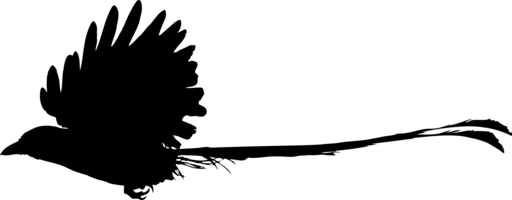
Red-billed Blue Magpie
Urocissa erythroryncha
Silhouette: Lip Kee Yap (vectorized by T. Michael Keesey) · PhyloPic
- KingdomAnimalia (Animals)
- PhylumChordata (Chordates)
- ClassAves (Birds)
- OrderPasseriformes (Perching Birds)
- FamilyCorvidae (Crows, Jays, and Magpies)
- GenusUrocissa (Blue-Magpies)
- SpeciesUrocissa erythroryncha (Red-billed Blue Magpie)
About the Red-billed Blue Magpie
The red-billed blue magpie (Urocissa erythroryncha) is a species of bird (magpie) in the crow family, Corvidae. It is about the same size as the Eurasian magpie, but has a much longer tail, one of the longest of any corvid. It is 65–68 cm (25.5–27 in) long and weighs 196–232 g (6.9–8.2 oz).
The red-billed blue magpie was described by French polymath Georges-Louis Leclerc, Comte de Buffon in 1775 in his Histoire Naturelle des Oiseaux. The bird was also illustrated in a hand-coloured plate engraved by François-Nicolas Martinet in the Planches Enluminées D'Histoire Naturelle which was produced under the supervision of Edme-Louis Daubenton to accompany Buffon's text. Neither the plate caption nor Buffon's description included a scientific name, but in 1783, Dutch naturalist Pieter Boddaert coined the binomial name Corvus erythrorynchus in his catalogue of the Planches Enluminées. The specimen described by Buffon had come from China, but the type location was restricted to Canton by Hugh Birckhead in 1937. The red-billed blue magpie is now one of five species placed in the genus Urocissa that was introduced by German ornithologist Jean Cabanis in 1850. The name of the genus... Wikipedia →
Recent sightings of Red-billed Blue Magpie in Kaeng Krachan National Park
LIVEiNaturalistClosest Relatives at Kaeng Krachan National Park

 Racket-tailed Treepie
Crypsirina temia

 Common Green Magpie
Cissa chinensis

Ratchet-tailed Treepie
Temnurus temnurus

 Large-billed Crow
Corvus macrorhynchos

Rufous Treepie
Dendrocitta vagabunda

Crested Jay
Platylophus galericulatus

Gray Treepie
Dendrocitta formosae

 White-rumped Shama
Copsychus malabaricus

Black-naped Monarch
Hypothymis azurea
 Ayeyarwady Bulbul
Pycnonotus blanfordi

 Greater Racket-tailed Drongo
Dicrurus paradiseus

Stripe-throated Bulbul
Pycnonotus finlaysoni
Global Distribution
Warmer areas are where this animal is recorded most often.
Parks Where Found
| # | Park | Country | Daily sighting probability |
|---|---|---|---|
| 1 | Jim Corbett National Park | 🇮🇳 India | |
| 2 | Doi Inthanon National Park | 🇹🇭 Thailand | |
| 3 | Chitwan National Park | 🇳🇵 Nepal | |
| 4 | Langtang National Park | 🇳🇵 Nepal | |
| 5 | Royal Bardia National Park | 🇳🇵 Nepal | |
| 6 | Khao Yai National Park | 🇹🇭 Thailand | |
| 7 | Kaeng Krachan National Park | 🇹🇭 Thailand | |
| 8 | Jiuzhaigou National Park | 🇨🇳 China | |
| 9 | Cuc Phuong National Park | 🇻🇳 Vietnam |
Quick answers
What are the chances of seeing a Red-billed Blue Magpie in Kaeng Krachan National Park?
Under 5% of wildlife watchers report a Red-billed Blue Magpie sighting in Kaeng Krachan National Park, based on 7 verified sightings from GBIF citizen-science data.
When is the best time to see Red-billed Blue Magpie in Kaeng Krachan National Park?
February has the highest sighting rate for Red-billed Blue Magpie in Kaeng Krachan National Park in our monthly data.