
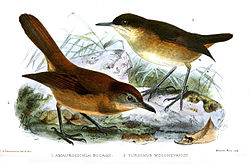


Brown Illadopsis
Illadopsis fulvescens
Silhouette: Sheatherius · PhyloPic
- KingdomAnimalia (Animals)
- PhylumChordata (Chordates)
- ClassAves (Birds)
- OrderPasseriformes (Perching Birds)
- FamilyPellorneidae (Ground Babblers and Allies)
- GenusIlladopsis (Illadopsises)
- SpeciesIlladopsis fulvescens (Brown Illadopsis)
About the Brown Illadopsis
The brown illadopsis (Illadopsis fulvescens) or brown thrush-babbler, is a species of bird in the family Pellorneidae. The species was first described by John Cassin in 1859. It is widely spread throughout the African tropical rainforest. Its natural habitats are subtropical or tropical dry forests and subtropical or tropical moist lowland forests. Wikipedia →
Recent sightings of Brown Illadopsis in Kibale National Park
LIVEiNaturalistClosest Relatives at Kibale National Park

 Scaly-breasted Illadopsis
Illadopsis albipectus

Pale-breasted Illadopsis
Illadopsis rufipennis

Mountain Illadopsis
Illadopsis pyrrhoptera

 Common Bulbul
Pycnonotus barbatus

Olive-bellied Sunbird
Cinnyris chloropygius

 Little Greenbul
Eurillas virens

 Bronze Mannikin
Lonchura cucullata

Green-backed Camaroptera
Camaroptera brachyura

Gray-headed Negrofinch
Nigrita canicapillus

African Blue Flycatcher
Elminia longicauda

Vieillot's Weaver
Ploceus nigerrimus

Black-and-white Shrike-flycatcher
Bias musicus
Global Distribution
Warmer areas are where this animal is recorded most often.
Parks Where Found
| # | Park | Country | Daily sighting probability |
|---|---|---|---|
| 1 | Kibale National Park | 🇺🇬 Uganda | |
| 2 | Semuliki National Park | 🇺🇬 Uganda | |
| 3 | Bwindi Impenetrable National Park | 🇺🇬 Uganda | |
| 4 | Lake Mburo National Park | 🇺🇬 Uganda | |
| 5 | Virunga National Park | 🇨🇩 Democratic Republic of the Congo | |
| 6 | Queen Elizabeth National Park | 🇺🇬 Uganda | |
| 7 | Murchison Falls National Park | 🇺🇬 Uganda |
Quick answers
What are the chances of seeing a Brown Illadopsis in Kibale National Park?
About 30% of wildlife watchers report a Brown Illadopsis sighting in Kibale National Park, based on 516 verified sightings from GBIF citizen-science data.
When is the best time to see Brown Illadopsis in Kibale National Park?
December has the highest sighting rate for Brown Illadopsis in Kibale National Park in our monthly data.