

Bronze Mannikin
Lonchura cucullata
Silhouette: Ferran Sayol · PhyloPic
- KingdomAnimalia (Animals)
- PhylumChordata (Chordates)
- ClassAves (Birds)
- OrderPasseriformes (Perching Birds)
- FamilyEstrildidae (Waxbills and Allies)
- GenusLonchura (Typical Munias and Mannikins)
- SpeciesLonchura cucullata (Bronze Mannikin)
About the Bronze Mannikin
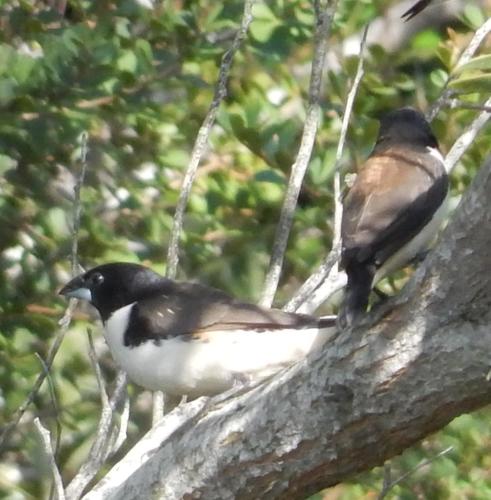
The bronze mannikin or bronze munia (Spermestes cucullata) is a small passerine (i.e. perching) bird of the Afrotropics. This very social estrildid finch is an uncommon to locally abundant bird in much of Africa south of the Sahara Desert, where it is resident, nomadic or irruptive in mesic savanna or forest margin habitats. It has an estimated global extent of occurrence of 23,600,000 km2 (9,100,000 sq mi). It is the smallest and most widespread of four munia species on the African mainland, the other being black-and-white, red-backed and magpie mannikin. It co-occurs with the Madagascar mannikin on the Comoro Islands, and was introduced to Puerto Rico. Especially in the West Africa, it is considered a pest in grain and rice fields. It is locally trapped for the pet bird trade.
The bronze mannikin was formally described in 1837 by the English naturalist William Swainson and given the binomial name Spermestes cucullata. The specific epithet is from Late Latin cucullatus meaning "hooded". The type locality is Senegal.
Two subspecies are recognised: S. c. cucullata Swainson, 1837 – Senegal and Gambia to south Sudan, Uganda, west Kenya and the island of Bioko S. c. scutata... Wikipedia →
Recent sightings of Bronze Mannikin in Kibale National Park
LIVEiNaturalistClosest Relatives at Kibale National Park

 Black-and-white Mannikin
Lonchura bicolor
Magpie Mannikin
Lonchura fringilloides

 Gray-headed Negrofinch
Nigrita canicapillus

White-breasted Negrofinch
Nigrita fusconotus

 Black-crowned Waxbill
Estrilda nonnula

Red-headed Bluebill
Spermophaga ruficapilla

Red-billed Firefinch
Lagonosticta senegala

Bar-breasted Firefinch
Lagonosticta rufopicta

Black-bellied Seedcracker
Pyrenestes ostrinus

African Firefinch
Lagonosticta rubricata

White-collared Oliveback
Nesocharis ansorgei

Green-backed Twinspot
Mandingoa nitidula
Global Distribution
Warmer areas are where this animal is recorded most often.
Parks Where Found
Quick answers
What are the chances of seeing a Bronze Mannikin in Kibale National Park?
About 50% of wildlife watchers report a Bronze Mannikin sighting in Kibale National Park, based on 1,053 verified sightings from GBIF citizen-science data.
When is the best time to see Bronze Mannikin in Kibale National Park?
November has the highest sighting rate for Bronze Mannikin in Kibale National Park in our monthly data.