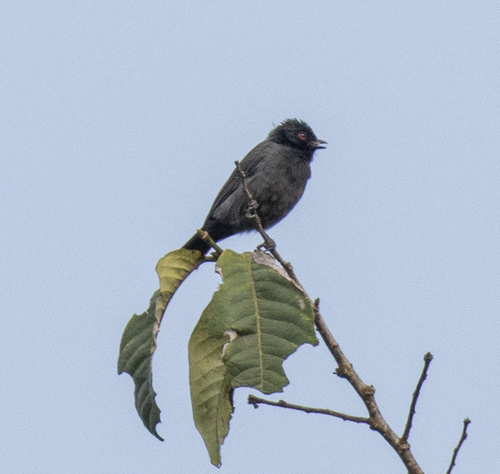

Dusky Tit
Parus funereus
Silhouette: Ferran Sayol · PhyloPic
- KingdomAnimalia (Animals)
- PhylumChordata (Chordates)
- ClassAves (Birds)
- OrderPasseriformes (Perching Birds)
- FamilyParidae (Tits, Chickadees, and Titmice)
- GenusParus (Great Tits and Allies)
- SpeciesParus funereus (Dusky Tit)
About the Dusky Tit
The dusky tit (Melaniparus funereus) is a species of bird in the tit family Paridae. It is native to the African tropical rainforest. The dusky tit was formerly one of the many species placed in the genus Parus. It was moved to the resurrected genus Melaniparus based on a molecular phylogenetic analysis published in 2013.
This bird has an unknown population size in the middle of Africa. The dusky tit is known for being almost entirely black with brownish or gray tones, depending on its sex. It is a relatively minor bird to a medium-sized bird; it may range from 13 to 15 cm depending on the sex. It is characterized by red eyes and a chirp that sounds like "dree di-di-di".
The males are mostly black, and the only distinct color resides in the eyes. The eyes will almost always be primarily red, but can vary from red to orange-red. Another key feature is its bill, which is smaller and thus easier to identify. In general, the male is the dominant sex. Therefore, its length will vary more towards the 14-15 cm mark.
The female has similar characteristics as the male; however, the upper body parts are more blackish-gray. Their tail is fringed gray and brown; however,... Wikipedia →
Recent sightings of Dusky Tit in Kibale National Park
LIVEiNaturalistClosest Relatives at Kibale National Park

 White-winged Black Tit
Parus leucomelas

 Common Bulbul
Pycnonotus barbatus

 Olive-bellied Sunbird
Cinnyris chloropygius

 Little Greenbul
Eurillas virens

 Bronze Mannikin
Lonchura cucullata

Green-backed Camaroptera
Camaroptera brachyura

Gray-headed Negrofinch
Nigrita canicapillus

African Blue Flycatcher
Elminia longicauda

Vieillot's Weaver
Ploceus nigerrimus

Black-and-white Shrike-flycatcher
Bias musicus

 Black-headed Paradise-Flycatcher
Terpsiphone rufiventer

Bronze Sunbird
Nectarinia kilimensis
Global Distribution
Warmer areas are where this animal is recorded most often.
Parks Where Found
| # | Park | Country | Daily sighting probability |
|---|---|---|---|
| 1 | Bwindi Impenetrable National Park | 🇺🇬 Uganda | |
| 2 | Nyungwe National Park | 🇷🇼 Rwanda | |
| 3 | Virunga National Park | 🇨🇩 Democratic Republic of the Congo | |
| 4 | Kibale National Park | 🇺🇬 Uganda | |
| 5 | Queen Elizabeth National Park | 🇺🇬 Uganda | |
| 6 | Semuliki National Park | 🇺🇬 Uganda | |
| 7 | Murchison Falls National Park | 🇺🇬 Uganda |
Quick answers
What are the chances of seeing a Dusky Tit in Kibale National Park?
About 10% of wildlife watchers report a Dusky Tit sighting in Kibale National Park, based on 177 verified sightings from GBIF citizen-science data.
When is the best time to see Dusky Tit in Kibale National Park?
February has the highest sighting rate for Dusky Tit in Kibale National Park in our monthly data.