


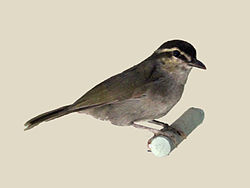


Green Hylia
Hylia prasina
Silhouette: Sheatherius · PhyloPic
- KingdomAnimalia (Animals)
- PhylumChordata (Chordates)
- ClassAves (Birds)
- OrderPasseriformes (Perching Birds)
- FamilyCettiidae (Bush Warblers and Allies)
- GenusHylia
- SpeciesHylia prasina (Green Hylia)
About the Green Hylia
The green hylia (Hylia prasina) is a monotypic genus widespread in tropical Africa, where it mostly inhabits the understory and mid-stratum of moist forest. It is a canopy insectivore which had been tentatively placed within the family of Cettiidae warblers, but in 2019 its assignment to a new family, the Hyliidae, was strongly supported.
Hylia prasina is a monotypic songbird that has proven difficult to place within the phylogenetic tree. Connections between Hylia and other genera have been attempted by comparing DNA sequences, physical similarities and even behavioural characteristics. None of these links have been sufficiently proven to allow definite classification of the green hylia.
The green hylia belongs to the order Passeriformes and the superfamily Sylvioidea, however the classification at family level is under dispute. The species is often attributed to the family Cettiidae (bush warblers) along with Scotocerca, Erythrocercus, Tesia, Cettia and Abroscopus. Investigation into indels does not support a strong relationship between Hylia and the Cettiidae.
Anatomically, the green hylia has similarities to sunbirds and warblers. Characteristics shared with sunbirds... Wikipedia →
Recent sightings of Green Hylia in Kibale National Park
LIVEiNaturalistClosest Relatives at Kibale National Park

 Tit-hylia
Pholidornis rushiae

 Common Bulbul
Pycnonotus barbatus

Olive-bellied Sunbird
Cinnyris chloropygius

 Little Greenbul
Eurillas virens

 Bronze Mannikin
Lonchura cucullata

Green-backed Camaroptera
Camaroptera brachyura

Gray-headed Negrofinch
Nigrita canicapillus

African Blue Flycatcher
Elminia longicauda

Vieillot's Weaver
Ploceus nigerrimus

Black-and-white Shrike-flycatcher
Bias musicus

 Black-headed Paradise-Flycatcher
Terpsiphone rufiventer

Bronze Sunbird
Nectarinia kilimensis
Global Distribution
Warmer areas are where this animal is recorded most often.
Parks Where Found
| # | Park | Country | Daily sighting probability |
|---|---|---|---|
| 1 | Semuliki National Park | 🇺🇬 Uganda | |
| 2 | Kibale National Park | 🇺🇬 Uganda | |
| 3 | Bwindi Impenetrable National Park | 🇺🇬 Uganda | |
| 4 | Virunga National Park | 🇨🇩 Democratic Republic of the Congo | |
| 5 | Queen Elizabeth National Park | 🇺🇬 Uganda | |
| 6 | Volcanoes National Park | 🇷🇼 Rwanda | |
| 7 | Lake Mburo National Park | 🇺🇬 Uganda | |
| 8 | Murchison Falls National Park | 🇺🇬 Uganda |
Quick answers
What are the chances of seeing a Green Hylia in Kibale National Park?
About 30% of wildlife watchers report a Green Hylia sighting in Kibale National Park, based on 645 verified sightings from GBIF citizen-science data.
When is the best time to see Green Hylia in Kibale National Park?
December has the highest sighting rate for Green Hylia in Kibale National Park in our monthly data.