


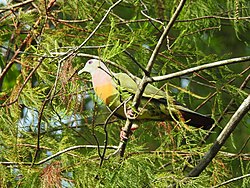

Pink-necked Green-Pigeon
Treron vernans
Silhouette: Sheatherius · PhyloPic
- KingdomAnimalia (Animals)
- PhylumChordata (Chordates)
- ClassAves (Birds)
- OrderColumbiformes (Pigeons and Doves)
- FamilyColumbidae (Pigeons and Doves)
- GenusTreron (Green-Pigeons)
- SpeciesTreron vernans (Pink-necked Green-Pigeon)
About the Pink-necked Green-Pigeon
The pink-necked green pigeon (Treron vernans) is a species of bird of the pigeon and dove family, Columbidae. It is a common species of Southeast Asia, found from Thailand, and Vietnam south through to the major islands of Indonesia and the Philippines (where it is called "punay"). It is a medium-sized pigeon with predominantly green plumage; only the male has the pink neck that gives the species its name. The species lives in a wide range of forested and human-modified habitats and is particularly found in open habitats. Its diet is dominated by fruit, in particular figs. Pairs lay two eggs in a flimsy twig nest in a tree, shrub, or hedge, and work together to incubate the eggs and raise the chicks. The species is thought to be an important disperser of fruit seeds. The species has adapted well to human changes to the environment, and can be found in crowded cities as long as fruiting trees are present.
Carl Linnaeus described the pink-necked green pigeon as Columba vernans in 1771. Its specific name, vernans, is derived from the Latin word vernantis for "brilliant" or "flourishing". It was later moved to the green pigeon genus Treron. Within that genus the species... Wikipedia →
Recent sightings of Pink-necked Green-Pigeon in Kinabatangan Wildlife Sanctuary
LIVEiNaturalistClosest Relatives at Kinabatangan Wildlife Sanctuary

 Little Green-Pigeon
Treron olax

Cinnamon-headed Green-Pigeon
Treron fulvicollis

Thick-billed Green-Pigeon
Treron curvirostra

Large Green-Pigeon
Treron capellei

Green Imperial-Pigeon
Ducula aenea

Asian Emerald Dove
Chalcophaps indica

 Pearl-necked Dove
Spilopelia chinensis

Zebra Dove
Geopelia striata

Pied Imperial Pigeon
Ducula bicolor

Mountain Imperial-Pigeon
Ducula badia

 Red Turtle Dove
Streptopelia tranquebarica

 Jambu Fruit-Dove
Ptilinopus jambu
Global Distribution
Warmer areas are where this animal is recorded most often.
Parks Where Found
| # | Park | Country | Daily sighting probability |
|---|---|---|---|
| 1 | Bako National Park | 🇲🇾 Malaysia | |
| 2 | Bali Barat National Park | 🇮🇩 Indonesia | |
| 3 | Kinabatangan Wildlife Sanctuary | 🇲🇾 Malaysia | |
| 4 | Sepilok | 🇲🇾 Malaysia | |
| 5 | Way Kambas National Park | 🇮🇩 Indonesia | |
| 6 | Gunung Leuser National Park | 🇮🇩 Indonesia | |
| 7 | Tanjung Puting National Park | 🇮🇩 Indonesia | |
| 8 | Tangkoko Nature Reserve | 🇮🇩 Indonesia | |
| 9 | Taman Negara National Park | 🇲🇾 Malaysia | |
| 10 | Kerinci Seblat National Park | 🇮🇩 Indonesia | |
| 11 | Danum Valley Conservation Area | 🇲🇾 Malaysia | |
| 12 | Kinabalu Park | 🇲🇾 Malaysia | |
| 13 | Cat Tien National Park | 🇻🇳 Vietnam | |
| 14 | Kaeng Krachan National Park | 🇹🇭 Thailand | |
| 15 | Komodo National Park | 🇮🇩 Indonesia | |
| 16 | Khao Sok National Park | 🇹🇭 Thailand | |
| 17 | Khao Yai National Park | 🇹🇭 Thailand |
Quick answers
What are the chances of seeing a Pink-necked Green-Pigeon in Kinabatangan Wildlife Sanctuary?
About 30% of wildlife watchers report a Pink-necked Green-Pigeon sighting in Kinabatangan Wildlife Sanctuary, based on 700 verified sightings from GBIF citizen-science data.
When is the best time to see Pink-necked Green-Pigeon in Kinabatangan Wildlife Sanctuary?
March has the highest sighting rate for Pink-necked Green-Pigeon in Kinabatangan Wildlife Sanctuary in our monthly data.