



White-headed Buffalo-Weaver
Dinemellia dinemelli
Silhouette: Sheatherius · PhyloPic
- KingdomAnimalia (Animals)
- PhylumChordata (Chordates)
- ClassAves (Birds)
- OrderPasseriformes (Perching Birds)
- FamilyPloceidae (Weavers and Allies)
- GenusDinemellia
- SpeciesDinemellia dinemelli (White-headed Buffalo-Weaver)
About the White-headed Buffalo-Weaver
The white-headed buffalo weaver or white-faced buffalo-weaver (Dinemellia dinemelli) is a species of passerine bird in the family Ploceidae native to East Africa. The buffalo part of its name derives from its habit of following the African buffalo, feeding on disturbed insects. Two subspecies are recognized.
The white-headed buffalo weaver was first described by the German naturalist Eduard Rüppell in 1845. Two subspecies of the white-headed buffalo weaver are now recognized. The white-headed buffalo weaver is 170 to 190 mm (6.7–7.5 in) in length and 57 to 85 g (2.0–3.0 oz) in weight. In addition to its white head and underparts, the white-headed buffalo weaver has a vividly orange-red rump and undertail coverts. Its thighs are dark brown. Narrow white bands can be found on the wings especially when stretch his wings sideways. Both sexes are similar in plumage and hard to differentiate. The bill is conical and black. D. d. dinemelli has a brown tail, whereas D. d. boehmi has a black tail.
The white-headed buffalo weaver is native to the African countries of Ethiopia, Kenya, Somalia, Sudan, Tanzania, and... Wikipedia →
Recent sightings of White-headed Buffalo-Weaver in Lake Manyara National Park
LIVEiNaturalistClosest Relatives at Lake Manyara National Park

 Black Bishop
Euplectes gierowii

Red-billed Quelea
Quelea quelea

Vitelline Masked-Weaver
Ploceus vitellinus

Lesser Masked-Weaver
Ploceus intermedius

Red Bishop
Euplectes orix

Baglafecht Weaver
Ploceus baglafecht

Grosbeak Weaver
Amblyospiza albifrons

Black-winged Bishop
Euplectes hordeaceus

Chestnut Weaver
Ploceus rubiginosus

Spectacled Weaver
Ploceus ocularis
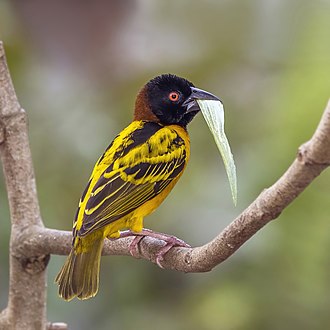
Village Weaver
Ploceus cucullatus

Speckle-fronted Weaver
Sporopipes frontalis
Global Distribution
Warmer areas are where this animal is recorded most often.
Parks Where Found
| # | Park | Country | Daily sighting probability |
|---|---|---|---|
| 1 | Meru National Park | 🇰🇪 Kenya | |
| 2 | Tarangire National Park | 🇹🇿 Tanzania | |
| 3 | Samburu National Reserve | 🇰🇪 Kenya | |
| 4 | Awash National Park | 🇪🇹 Ethiopia | |
| 5 | Tsavo West National Park | 🇰🇪 Kenya | |
| 6 | Amboseli National Park | 🇰🇪 Kenya | |
| 7 | Ruaha National Park | 🇹🇿 Tanzania | |
| 8 | Serengeti National Park | 🇹🇿 Tanzania | |
| 9 | Tsavo East National Park | 🇰🇪 Kenya | |
| 10 | Kidepo Valley National Park | 🇺🇬 Uganda | |
| 11 | Mkomazi National Park | 🇹🇿 Tanzania | |
| 12 | Masai Mara National Reserve | 🇰🇪 Kenya | |
| 13 | Ngorongoro Conservation Area | 🇹🇿 Tanzania | |
| 14 | Lake Manyara National Park | 🇹🇿 Tanzania | |
| 15 | Selous Game Reserve | 🇹🇿 Tanzania | |
| 16 | Mikumi National Park | 🇹🇿 Tanzania | |
| 17 | Arusha National Park | 🇹🇿 Tanzania |
Quick answers
What are the chances of seeing a White-headed Buffalo-Weaver in Lake Manyara National Park?
Under 5% of wildlife watchers report a White-headed Buffalo-Weaver sighting in Lake Manyara National Park, based on 6 verified sightings from GBIF citizen-science data.
When is the best time to see White-headed Buffalo-Weaver in Lake Manyara National Park?
April has the highest sighting rate for White-headed Buffalo-Weaver in Lake Manyara National Park in our monthly data.