


Sheep Frog
Hypopachus variolosus
Silhouette: Jose Carlos Arenas-Monroy · PhyloPic
- KingdomAnimalia (Animals)
- PhylumChordata (Chordates)
- ClassAmphibia (Amphibians)
- OrderAnura (Frogs and Toads)
- FamilyMicrohylidae (Narrow-mouthed Frogs)
- GenusHypopachus (Sheep Frogs)
- SpeciesHypopachus variolosus (Sheep Frog)
About the Sheep Frog
The northern sheep frog (Hypopachus variolosus) is native to Central America, Mexico, and extreme south Texas, United States. It occurs in the lowlands from Sonora, Mexico, to northern Costa Rica on the Pacific coast, and south Texas to Honduras on the Gulf of Mexico and Caribbean coasts. The sheep frog inhabits semiarid thornscrub, savannas, pasturelands, and open woodlands, as well as more humid, moist forest in the canyons, basins, foothills, and lower elevations of mountains slopes. It is a fossorial, burrowing frog that is seldom seen on the surface except at night after heavy rains when they emerge to breed. The sheep frog gets its name from its distinctive call that resembles a sheep's bleat. It is a diet specialist primarily feeding on termites and ants.
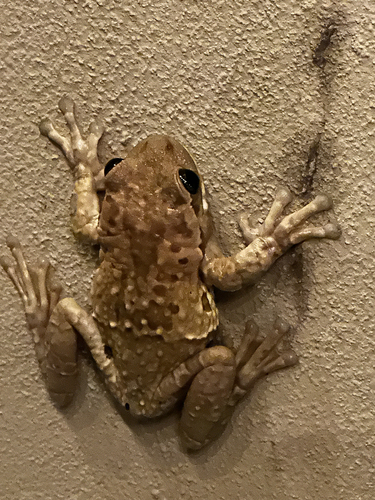
The sheep frog is a small, stout frog with short legs, ranging about 2.5-3.8 cm, with females growing larger than the males. The dorsal color ranges from tan, to reddish-tan, to various shades of brown with irregular black flecks or spots, which may be extensive on some individuals, or absent on others. An orange, red, or yellowish mid-dorsal stripe, running from the snout to the vent is present on some specimens, but may by absent, vague, or fragmented on others. It is a common species in some areas of its range, but it is uncommon in the US and listed as a threatened species in the state of Texas. Wikipedia →
Recent sightings of Sheep Frog in Las Baulas Marine National Park
LIVEiNaturalistClosest Relatives at Las Baulas Marine National Park
 Milk Frog
Trachycephalus macrotis

 Giant Marine Toad
Rhinella horribilis

 Mexican Smilisca
Smilisca baudinii

Stauffer's Tree Frog
Scinax staufferi

 Yellow Toad
Incilius luetkenii

Yellow Treefrog
Dendropsophus microcephalus

 Turbo White-lipped Frog
Leptodactylus poecilochilus

 Forrer's Grass Frog
Lithobates forreri
Global Distribution
Warmer areas are where this animal is recorded most often.
Parks Where Found
| # | Park | Country | Daily sighting probability |
|---|---|---|---|
| 1 | Santa Rosa National Park | 🇨🇷 Costa Rica | |
| 2 | Palo Verde National Park | 🇨🇷 Costa Rica | |
| 3 | Calakmul Biosphere Reserve | 🇲🇽 Mexico | |
| 4 | Tikal National Park | 🇬🇹 Guatemala | |
| 5 | Biotopo Cerro Cahuí | 🇬🇹 Guatemala | |
| 6 | Celaque National Park | 🇭🇳 Honduras | |
| 7 | Ría Lagartos Biosphere Reserve | 🇲🇽 Mexico | |
| 8 | Ostional Wildlife Refuge | 🇨🇷 Costa Rica | |
| 9 | Cockscomb Basin Wildlife Sanctuary | 🇧🇿 Belize | |
| 10 | Arrecifes de Cozumel National Park | 🇲🇽 Mexico | |
| 11 | Sian Ka'an Biosphere Reserve | 🇲🇽 Mexico | |
| 12 | Celestún Biosphere Reserve | 🇲🇽 Mexico | |
| 13 | Las Baulas Marine National Park | 🇨🇷 Costa Rica | |
| 14 | Cabo Blanco Absolute Nature Reserve | 🇨🇷 Costa Rica | |
| 15 | Braulio Carrillo National Park | 🇨🇷 Costa Rica | |
| 16 | Carara National Park | 🇨🇷 Costa Rica | |
| 17 | Monteverde Cloud Forest Reserve | 🇨🇷 Costa Rica |