

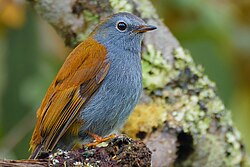
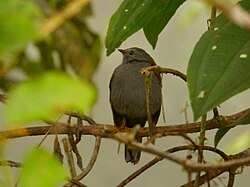


Andean Solitaire
Myadestes ralloides
Silhouette: Francesco "Architetto" Rollandin · PhyloPic
- KingdomAnimalia (Animals)
- PhylumChordata (Chordates)
- ClassAves (Birds)
- OrderPasseriformes (Perching Birds)
- FamilyTurdidae (Thrushes)
- GenusMyadestes (Typical Solitaires and Hawaiian Thrushes)
- SpeciesMyadestes ralloides (Andean Solitaire)
About the Andean Solitaire
The Andean solitaire (Myadestes ralloides) is a species of bird in the family Turdidae, the thrushes. It is found in Bolivia, Colombia, Ecuador, Peru, and Venezuela. The Andean solitaire was originally described in 1840 as Muscipeta ralloides. It was later reassigned to its present genus Myadestes that had been erected in 1838. During the middle of the twentieth century several authors treated what are now the Andean solitaire, the black-faced solitaire (M. malanops), and varied solitaire (M. coloratus) as conspecific. They are not well differentiated and form a superspecies.
The Andean solitaire has these four subspecies: M. r. plumbeiceps Hellmayr, 1921 M. r. candelae Meyer de Schauensee, 1947 M. r. venezuelensis Sclater, PL, 1856 M. r. ralloides (D'Orbigny, 1840) A genetic study published in 2007 determined that some of the subspecies may deserve full species status. Based on that study and vocal differences, the Clements taxonomy recognizes three groups within the species: M. r. plumbeiceps and M. r. ralloides as single-species "groups" and M. r. candelae plus M. r. venezuelensis as the third group.
The Andean solitaire is 17 to... Wikipedia →
Recent sightings of Andean Solitaire in Manu National Park
LIVEiNaturalistClosest Relatives at Manu National Park

 Black-billed Thrush
Turdus ignobilis

Hauxwell's Thrush
Turdus hauxwelli

 Swainson's Thrush
Catharus ustulatus

 White-eared Solitaire
Entomodestes leucotis

Chiguanco Thrush
Turdus chiguanco

Yellow-throated Nightingale-Thrush
Catharus dryas

Great Thrush
Turdus fuscater

White-necked Thrush
Turdus albicollis

Lawrence's Thrush
Turdus lawrencii

Andean Slaty Thrush
Turdus nigriceps

Glossy-black Thrush
Turdus serranus

Creamy-bellied Thrush
Turdus amaurochalinus
Global Distribution
Warmer areas are where this animal is recorded most often.
Parks Where Found
| # | Park | Country | Daily sighting probability |
|---|---|---|---|
| 1 | Farallones de Cali National Natural Park | 🇨🇴 Colombia | |
| 2 | Los Nevados National Natural Park | 🇨🇴 Colombia | |
| 3 | Henri Pittier National Park | 🇻🇪 Venezuela | |
| 4 | Manu National Park | 🇵🇪 Peru | |
| 5 | Puracé National Natural Park | 🇨🇴 Colombia | |
| 6 | Chingaza National Natural Park | 🇨🇴 Colombia | |
| 7 | Podocarpus National Park | 🇪🇨 Ecuador | |
| 8 | Cordillera Azul National Park | 🇵🇪 Peru | |
| 9 | Madidi National Park | 🇧🇴 Bolivia |
Quick answers
What are the chances of seeing a Andean Solitaire in Manu National Park?
About 10% of wildlife watchers report a Andean Solitaire sighting in Manu National Park, based on 705 verified sightings from GBIF citizen-science data.
When is the best time to see Andean Solitaire in Manu National Park?
December has the highest sighting rate for Andean Solitaire in Manu National Park in our monthly data.