
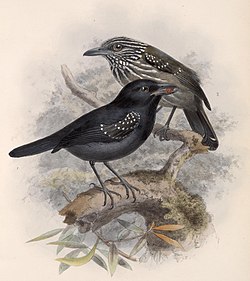



Black-hooded Antshrike
Thamnophilus bridgesi
Silhouette: Sheatherius · PhyloPic
- KingdomAnimalia (Animals)
- PhylumChordata (Chordates)
- ClassAves (Birds)
- OrderPasseriformes (Perching Birds)
- FamilyThamnophilidae (Typical Antbirds)
- GenusThamnophilus (Typical Antshrikes)
- SpeciesThamnophilus bridgesi (Black-hooded Antshrike)
About the Black-hooded Antshrike
The black-hooded antshrike (Thamnophilus bridgesi) is a species of bird in subfamily Thamnophilinae of family Thamnophilidae, the "typical antbirds". It is found in Costa Rica and Panama. The black-hooded antshrike was described by the English zoologist Philip Sclater in 1856 and given its current binomial name Thamnophilus bridgesi. The specific epithet honors a Mr. Bridges who collected the holotype. (Sclater did not publish Bridges' given name.)
The black-hooded antshrike is monotypic. The black-hooded antshrike is 15 to 17 cm (5.9 to 6.7 in) long and weighs 26 to 27 g (0.92 to 0.95 oz). Members of genus Thamnophilus are largish members of the antbird family; all have stout bills with a hook like those of true shrikes. This species exhibits some sexual dimorphism. Adult males are mostly black. They have a white patch between their scapulars, small white dots on their wing coverts, and dark gray belly and undertail coverts. Adult females have blackish gray forehead, crown, and face with narrow white streaks. Their upperparts and wings are very dark grayish brown with white-edged scapulars and white-spotted wing coverts. Their tail is... Wikipedia →
Recent sightings of Black-hooded Antshrike in Manuel Antonio National Park
LIVEiNaturalistClosest Relatives at Manuel Antonio National Park

 Barred Antshrike
Thamnophilus doliatus

Chestnut-backed Antbird
Myrmeciza exsul

Dot-winged Antwren
Microrhopias quixensis

Bicolored Antbird
Gymnopithys leucaspis

Dusky Antbird
Cercomacra tyrannina

Slaty Antwren
Myrmotherula schisticolor

Great Antshrike
Taraba major

 Great Kiskadee
Pitangus sulphuratus

 Great-tailed Grackle
Quiscalus mexicanus

 Tropical Kingbird
Tyrannus melancholicus

Scarlet-rumped Tanager
Ramphocelus passerinii

Palm Tanager
Thraupis palmarum
Global Distribution
Warmer areas are where this animal is recorded most often.
Parks Where Found
| # | Park | Country | Daily sighting probability |
|---|---|---|---|
| 1 | Carara National Park | 🇨🇷 Costa Rica | |
| 2 | Corcovado National Park | 🇨🇷 Costa Rica | |
| 3 | Manuel Antonio National Park | 🇨🇷 Costa Rica | |
| 4 | Piedras Blancas National Park | 🇨🇷 Costa Rica | |
| 5 | Marino Ballena National Park | 🇨🇷 Costa Rica | |
| 6 | Coiba National Park | 🇵🇦 Panama | |
| 7 | La Amistad International Park (Panama) | 🇵🇦 Panama | |
| 8 | Chirripó National Park | 🇨🇷 Costa Rica | |
| 9 | Arenal Volcano National Park | 🇨🇷 Costa Rica | |
| 10 | Tapantí-Macizo de la Muerte National Park | 🇨🇷 Costa Rica | |
| 11 | Monteverde Cloud Forest Reserve | 🇨🇷 Costa Rica | |
| 12 | Tenorio Volcano National Park | 🇨🇷 Costa Rica |
Quick answers
What are the chances of seeing a Black-hooded Antshrike in Manuel Antonio National Park?
About 40% of wildlife watchers report a Black-hooded Antshrike sighting in Manuel Antonio National Park, based on 1,074 verified sightings from GBIF citizen-science data.
When is the best time to see Black-hooded Antshrike in Manuel Antonio National Park?
January has the highest sighting rate for Black-hooded Antshrike in Manuel Antonio National Park in our monthly data.