

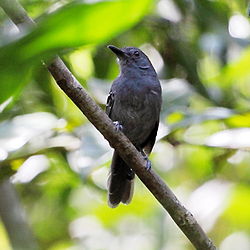



Dusky Antbird
Cercomacra tyrannina
Silhouette: Sheatherius · PhyloPic
- KingdomAnimalia (Animals)
- PhylumChordata (Chordates)
- ClassAves (Birds)
- OrderPasseriformes (Perching Birds)
- FamilyThamnophilidae (Typical Antbirds)
- GenusCercomacra (Cercomacra Antbirds)
- SpeciesCercomacra tyrannina (Dusky Antbird)
About the Dusky Antbird
The dusky antbird or tyrannine antbird (Cercomacroides tyrannina) is a passerine bird in subfamily Thamnophilinae of family Thamnophilidae, the "typical antbirds". It is found from Mexico south through Central America and in Brazil, Colombia, Ecuador, French Guiana, Guyana, Suriname, and Venezuela.
The dusky antbird was described by the English zoologist Philip Sclater in 1855 and given the binomial name Pyriglena tyrannina. The species was subsequently placed in genus Cercomacra but a molecular phylogenetic study published in 2014 found that Cercomacra, as then defined, was polyphyletic. The genus was split to create two monophyletic genera, and six species including the dusky antbird were moved to the newly erected genus Cercomacroides.
The dusky antbird has these four subspecies: C. t. crepera (Bangs, 1901) C. t. tyrannina (Sclater, PL, 1855) C. t. vicina (Todd, 1927) C. t. saturatior (Chubb, C, 1918) What is now Willis's antbird (C. laeta) was originally described as a fifth subspecies. A 1997 study found that Willis's antbird differed from the other dusky antbird subspecies in both plumage and voice and as a result, Willis's antbird was promoted... Wikipedia →
Recent sightings of Dusky Antbird in Manuel Antonio National Park
LIVEiNaturalistClosest Relatives at Manuel Antonio National Park

 Black-hooded Antshrike
Thamnophilus bridgesi

Chestnut-backed Antbird
Myrmeciza exsul

Barred Antshrike
Thamnophilus doliatus

Dot-winged Antwren
Microrhopias quixensis

Bicolored Antbird
Gymnopithys leucaspis

Slaty Antwren
Myrmotherula schisticolor

Great Antshrike
Taraba major

 Great Kiskadee
Pitangus sulphuratus

 Great-tailed Grackle
Quiscalus mexicanus

 Tropical Kingbird
Tyrannus melancholicus

Scarlet-rumped Tanager
Ramphocelus passerinii

Palm Tanager
Thraupis palmarum
Global Distribution
Warmer areas are where this animal is recorded most often.
Parks Where Found
Quick answers
What are the chances of seeing a Dusky Antbird in Manuel Antonio National Park?
Under 5% of wildlife watchers report a Dusky Antbird sighting in Manuel Antonio National Park, based on 6 verified sightings from GBIF citizen-science data.
When is the best time to see Dusky Antbird in Manuel Antonio National Park?
July has the highest sighting rate for Dusky Antbird in Manuel Antonio National Park in our monthly data.