

Yellow-shouldered Widowbird
Euplectes macroura
Silhouette: Sheatherius · PhyloPic
- KingdomAnimalia (Animals)
- PhylumChordata (Chordates)
- ClassAves (Birds)
- OrderPasseriformes (Perching Birds)
- FamilyPloceidae (Weavers and Allies)
- GenusEuplectes (Bishops and Widowbirds)
- SpeciesEuplectes macroura (Yellow-shouldered Widowbird)
About the Yellow-shouldered Widowbird
The yellow-mantled widowbird (Euplectes macroura), also known as the yellow-backed widow, is a species of bird in the family Ploceidae. The yellow-mantled widowbird was formally described in 1789 by the German naturalist Johann Friedrich Gmelin in his revised and expanded edition of Carl Linnaeus's Systema Naturae. He placed it with the crossbills in the genus Loxia and coined the binomial name Loxia macroura. Gmelin specified the locality as "Whydah"; this is Ouidah on the coast of Benin in West Africa. The specific epithet is from Ancient Greek makros meaning "long" and -ouros meaning "tailed". The yellow-mantled widowbird is now one of 18 species placed in the genus Euplectes that was introduced in 1829 by the English naturalist William Swainson.
E. m. macrocercus (Lichtenstein, MHC, 1823) – Ethiopia, Uganda and west Kenya E. m. macroura (Gmelin, JF, 1789) – Senegal and Gambia to south Sudan and southwest Kenya and south to Zambia, Malawi, Zimbabwe and west Mozambique
E. m. conradsi (Berger, 1908) – Ukerewe Island in Lake Victoria Males are larger than females and acquire longer tails and striking black and golden yellow plumages in the breeding... Wikipedia →
Recent sightings of Yellow-shouldered Widowbird in Masai Mara National Reserve
LIVEiNaturalistClosest Relatives at Masai Mara National Reserve

 Yellow-rumped Widowbird
Euplectes capensis

Fan-tailed Widowbird
Euplectes axillaris

Jackson's Widowbird
Euplectes jacksoni

Red-collared Widowbird
Euplectes ardens

White-winged Widowbird
Euplectes albonotatus

Long-tailed Widow-bird
Euplectes progne

Red Bishop
Euplectes orix

Black Bishop
Euplectes gierowii
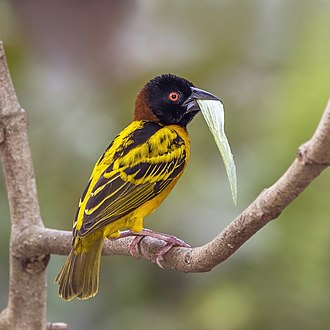
Village Weaver
Ploceus cucullatus

Speckle-fronted Weaver
Sporopipes frontalis

Spectacled Weaver
Ploceus ocularis

White-headed Buffalo-Weaver
Dinemellia dinemelli
Global Distribution
Warmer areas are where this animal is recorded most often.
Parks Where Found
| # | Park | Country | Daily sighting probability |
|---|---|---|---|
| 1 | Masai Mara National Reserve | 🇰🇪 Kenya | |
| 2 | Kafue National Park | 🇿🇲 Zambia | |
| 3 | Serengeti National Park | 🇹🇿 Tanzania | |
| 4 | Murchison Falls National Park | 🇺🇬 Uganda | |
| 5 | Virunga National Park | 🇨🇩 Democratic Republic of the Congo | |
| 6 | Kidepo Valley National Park | 🇺🇬 Uganda | |
| 7 | South Luangwa National Park | 🇿🇲 Zambia | |
| 8 | Mikumi National Park | 🇹🇿 Tanzania | |
| 9 | Ngorongoro Conservation Area | 🇹🇿 Tanzania | |
| 10 | Lake Mburo National Park | 🇺🇬 Uganda | |
| 11 | Queen Elizabeth National Park | 🇺🇬 Uganda | |
| 12 | Kibale National Park | 🇺🇬 Uganda |
Quick answers
What are the chances of seeing a Yellow-shouldered Widowbird in Masai Mara National Reserve?
About 10% of wildlife watchers report a Yellow-shouldered Widowbird sighting in Masai Mara National Reserve, based on 469 verified sightings from GBIF citizen-science data.
When is the best time to see Yellow-shouldered Widowbird in Masai Mara National Reserve?
April has the highest sighting rate for Yellow-shouldered Widowbird in Masai Mara National Reserve in our monthly data.