


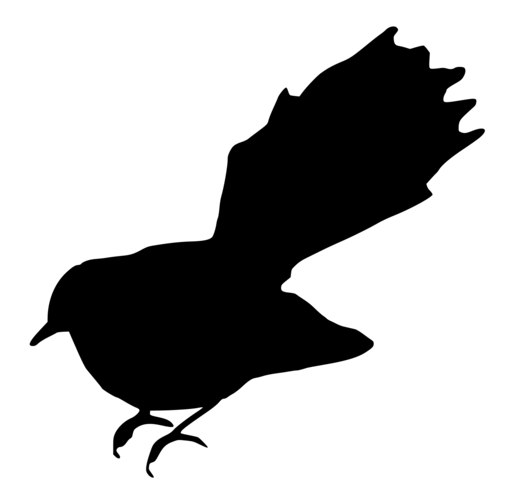
Willie Wagtail
Rhipidura leucophrys
Silhouette: Michael Scroggie · PhyloPic
- KingdomAnimalia (Animals)
- PhylumChordata (Chordates)
- ClassAves (Birds)
- OrderPasseriformes (Perching Birds)
- FamilyRhipiduridae (Fantails)
- GenusRhipidura (Fantails)
- SpeciesRhipidura leucophrys (Willie Wagtail)
About the Willie Wagtail
The willie wagtail (Rhipidura leucophrys) (also spelt willy wagtail) is a passerine bird native to Australia, New Guinea, the Solomon Islands, the Bismarck Archipelago, and Eastern Indonesia. It is a common and familiar bird throughout much of its range, living in most habitats apart from thick forest. Measuring 19–21.5 cm (7+1⁄2–8+1⁄2 in) in length, the willie wagtail is contrastingly coloured with almost entirely black upperparts and white underparts; the male and female have similar plumage.
Three subspecies are recognised; Rhipidura leucophrys leucophrys from central and southern Australia, the smaller R. l. picata from northern Australia, and the larger R. l. melaleuca from New Guinea and islands in its vicinity. It is unrelated to the true wagtails of the genus Motacilla; it is a member of the fantail genus Rhipidura and is a part of a "core corvine" group that includes true crows and ravens, drongos and birds of paradise. Within this group, fantails are placed either in the family Dicruridae, alongside drongos, or in their own small family, Rhipiduridae.
The willie wagtail is insectivorous and spends much time chasing prey in open habitat. Its common name is derived from its habit of wagging its tail horizontally when foraging on the ground. Aggressive and territorial, the willie wagtail will often harass much larger birds such as the laughing kookaburra and wedge-tailed eagle. It has responded well to human alteration of the landscape and is a common sight in urban lawns, parks, and gardens. It is widely featured in Aboriginal folklore around Australia and New Guinea in a variety of roles, from stealer of secrets and liar to a good omen for successful crops. Wikipedia →
Recent sightings of Willie Wagtail in Noosa National Park
LIVEiNaturalistClosest Relatives at Noosa National Park

 Grey Fantail
Rhipidura albiscapa

Rufous Fantail
Rhipidura rufifrons

 Torresian Crow
Corvus orru

 Noisy Friarbird
Philemon corniculatus

 Lewin's Honeyeater
Meliphaga lewinii

Noisy Miner
Manorina melanocephala

 Pied Currawong
Strepera graculina

 Australian Magpie
Gymnorhina tibicen

Brown Honeyeater
Lichmera indistincta

 Spangled Drongo
Dicrurus bracteatus

Australasian Figbird
Sphecotheres vieilloti

Eastern Whipbird
Psophodes olivaceus
Global Distribution
Warmer areas are where this animal is recorded most often.
Parks Where Found
| # | Park | Country | Daily sighting probability |
|---|---|---|---|
| 1 | Uluru-Kata Tjuta National Park | 🇦🇺 Australia | |
| 2 | Raja Ampat | 🇮🇩 Indonesia | |
| 3 | Kakadu National Park | 🇦🇺 Australia | |
| 4 | Flinders Ranges National Park | 🇦🇺 Australia | |
| 5 | Flinders Chase | 🇦🇺 Australia | |
| 6 | Grampians National Park | 🇦🇺 Australia | |
| 7 | Nitmiluk National Park | 🇦🇺 Australia | |
| 8 | Kosciuszko National Park | 🇦🇺 Australia | |
| 9 | Great Otway National Park | 🇦🇺 Australia | |
| 10 | Blue Mountains National Park | 🇦🇺 Australia | |
| 11 | Ningaloo Marine Park | 🇦🇺 Australia | |
| 12 | Springbrook National Park | 🇦🇺 Australia | |
| 13 | Daintree National Park | 🇦🇺 Australia | |
| 14 | Noosa National Park | 🇦🇺 Australia | |
| 15 | Booderee National Park | 🇦🇺 Australia | |
| 16 | Cape Range | 🇦🇺 Australia | |
| 17 | Litchfield National Park | 🇦🇺 Australia | |
| 18 | Royal National Park | 🇦🇺 Australia | |
| 19 | Wilsons Promontory National Park | 🇦🇺 Australia | |
| 20 | Lamington National Park | 🇦🇺 Australia |
Quick answers
What are the chances of seeing a Willie Wagtail in Noosa National Park?
About 10% of wildlife watchers report a Willie Wagtail sighting in Noosa National Park, based on 34 verified sightings from GBIF citizen-science data.
When is the best time to see Willie Wagtail in Noosa National Park?
April has the highest sighting rate for Willie Wagtail in Noosa National Park in our monthly data.