

Goldman's Nectar Bat
Lonchophylla concava
Silhouette: Patricia Pilatti · PhyloPic
- KingdomAnimalia (Animals)
- PhylumChordata (Chordates)
- ClassMammalia (Mammals)
- OrderChiroptera (Bats)
- FamilyPhyllostomidae (New World Leaf-nosed Bats)
- GenusLonchophylla (Nectar Bats)
- SpeciesLonchophylla concava (Goldman's Nectar Bat)
About the Goldman's Nectar Bat
Lonchophylla concava is a species of leaf-nosed bat found in Central and South America. It was long considered a synonym of Goldman's nectar bat, though is now recognized as distinct. It consumes nectar and pollen. Lonchophylla concava was described as a new species in 1914 by Edward Alphonso Goldman. Goldman had collected the holotype from eastern Panama in 1912. In 1966, Handley published that L. concava was a synonym of Goldman's nectar bat (L. mordax); this was maintained until a 2005 publication asserted that there were major physical difference between the two taxa, and thus L. concava should be recognized as a separate species.
Lonchophylla concava has a forearm length of 32.0–34.6 mm (1.26–1.36 in). Females weight 7.0–8.0 g (0.25–0.28 oz) while males weigh 7.0–9.0 g (0.25–0.32 oz). Lonchophylla concava is nectarivorous and palynivorous, consuming the nectar and pollen of Mucuna and banana plants. It also consumes some butterflies and moths. During the day, it roosts in caves.
Lonchophylla concava is found in Central American and South America, including Costa Rica, Panama, Colombia, and Ecuador... Wikipedia →
Recent sightings of Goldman's Nectar Bat in Piedras Blancas National Park
LIVEiNaturalistClosest Relatives at Piedras Blancas National Park

 orange nectar bat
Lonchophylla robusta

 Common tent-making Bat
Uroderma bilobatum
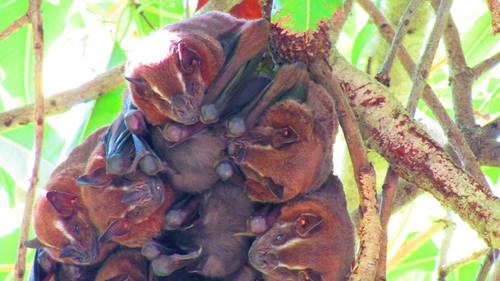
 Great Fruit-eating Bat
Artibeus lituratus

Jamaican Fruit-eating Bat
Artibeus jamaicensis

 Pallas's Long-tongued Bat
Glossophaga soricina

Proboscis Bat
Rhynchonycteris naso

 Greater Sac-winged Bat
Saccopteryx bilineata

Spix's Disk-winged Bat
Thyroptera tricolor

Gray Sac-winged Bat
Balantiopteryx plicata

 Thomas's Yellow Bat
Rhogeessa io
Global Distribution
Warmer areas are where this animal is recorded most often.
Parks Where Found
| # | Park | Country | Daily sighting probability |
|---|---|---|---|
| 1 | Piedras Blancas National Park | 🇨🇷 Costa Rica |
More parks will be added in future updates.