

Pallas's Long-tongued Bat
Glossophaga soricina
Silhouette: Edwin Price · PhyloPic
- KingdomAnimalia (Animals)
- PhylumChordata (Chordates)
- ClassMammalia (Mammals)
- OrderChiroptera (Bats)
- FamilyPhyllostomidae (New World Leaf-nosed Bats)
- GenusGlossophaga (Long-tongued Bats)
- SpeciesGlossophaga soricina (Pallas's Long-tongued Bat)
About the Pallas's Long-tongued Bat
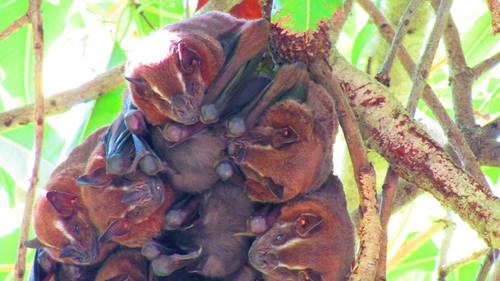
Pallas's long-tongued bat (Glossophaga soricina) is a South and Central American bat with a fast metabolism that feeds on nectar. It has the fastest metabolism ever recorded in a mammal, similar to those of hummingbirds. Although it uses 50% of its stored fat over the course of a day, over 80% of its energy comes directly from the simple sugars that compose its diet of nectar, without being stored in any form. It will also feed on pollen, flower parts, fruit and insects.
A 2013 study determined that their tongues have a mopping ability that is powered by blood, a phenomenon unique in nature. Elongated hairs at the tongue's tip, which normally lie flat, become engorged with blood when the tongue is protruded. As a result, the hairs stand in erect rows, perpendicular to the tongue. The tongue tip increases by over 50 percent in length, contracting its width to squeeze enlarged vascular sinuses along the tongue's length, that are directly connected to the hairs. During this process tissue capillaries turn from pink (little blood) to dark red. The blood vessel networks that enter the tip of the tongue are fringed by muscle fibers, which contract to compress... Wikipedia →
Recent sightings of Pallas's Long-tongued Bat in Piedras Blancas National Park
LIVEiNaturalistClosest Relatives at Piedras Blancas National Park

 Common tent-making Bat
Uroderma bilobatum
 Great Fruit-eating Bat
Artibeus lituratus

 orange nectar bat
Lonchophylla robusta

Jamaican Fruit-eating Bat
Artibeus jamaicensis

Goldman's Nectar Bat
Lonchophylla concava

Proboscis Bat
Rhynchonycteris naso

 Greater Sac-winged Bat
Saccopteryx bilineata

Spix's Disk-winged Bat
Thyroptera tricolor

Gray Sac-winged Bat
Balantiopteryx plicata

 Thomas's Yellow Bat
Rhogeessa io
Global Distribution
Warmer areas are where this animal is recorded most often.
Parks Where Found
| # | Park | Country | Daily sighting probability |
|---|---|---|---|
| 1 | Santa Rosa National Park | 🇨🇷 Costa Rica | |
| 2 | Emas National Park | 🇧🇷 Brazil | |
| 3 | Piedras Blancas National Park | 🇨🇷 Costa Rica | |
| 4 | Monteverde Cloud Forest Reserve | 🇨🇷 Costa Rica |