
Thomas's Yellow Bat
Rhogeessa io
Silhouette: Margot Michaud · PhyloPic
- KingdomAnimalia (Animals)
- PhylumChordata (Chordates)
- ClassMammalia (Mammals)
- OrderChiroptera (Bats)
- FamilyVespertilionidae (Evening Bats)
- GenusRhogeessa (Little Yellow Bats)
- SpeciesRhogeessa io (Thomas's Yellow Bat)
About the Thomas's Yellow Bat
Thomas's yellow bat (Rhogeessa io) is a species of bat from the family Vespertilionidae. Thomas's yellow bat was given its binomial nomenclature by Oldfield Thomas in 1903 as Rhogeessa io. Synonyms for the species include Rhogeessa bombyx (Thomas, 1913), Rhogeessa riparia (Goodwin, 1958), and Rhogeessa velilla (Thomas, 1903). The Thomas's yellow bat was formerly included as a subspecies of the black-winged little yellow bat, but was considered distinct in 1996.
The species needs taxonomic review for a number of reasons. One of these reasons includes the possibility that subspecies of the Thomas's yellow bat may be their own species. Thomas's yellow bat is native to Bolivia, Brazil, Colombia, Costa Rica, Ecuador, French Guiana, Guyana, Nicaragua, Panama, Suriname, Trinidad and Tobago, and Venezuela. It is listed as "Least Concern" by the IUCN Red List due to its wide distribution, presumed large population, occurrence in a number of protected areas, having some degree of tolerance to habitat modification, and unlikeliness of population decline at the rate to qualify for a more threatened listing.
Thomas's yellow bat... Wikipedia →
Recent sightings of Thomas's Yellow Bat in Piedras Blancas National Park
LIVEiNaturalistClosest Relatives at Piedras Blancas National Park

 Proboscis Bat
Rhynchonycteris naso

 Greater Sac-winged Bat
Saccopteryx bilineata

Common tent-making Bat
Uroderma bilobatum
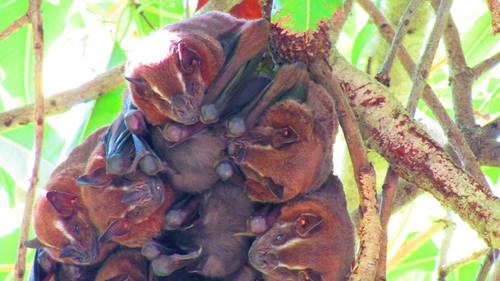
 Great Fruit-eating Bat
Artibeus lituratus

 orange nectar bat
Lonchophylla robusta

Spix's Disk-winged Bat
Thyroptera tricolor

Jamaican Fruit-eating Bat
Artibeus jamaicensis

 Pallas's Long-tongued Bat
Glossophaga soricina

Gray Sac-winged Bat
Balantiopteryx plicata

Goldman's Nectar Bat
Lonchophylla concava
Global Distribution
Warmer areas are where this animal is recorded most often.
Parks Where Found
| # | Park | Country | Daily sighting probability |
|---|---|---|---|
| 1 | Piedras Blancas National Park | 🇨🇷 Costa Rica | |
| 2 | Darién National Park | 🇵🇦 Panama | |
| 3 | Braulio Carrillo National Park | 🇨🇷 Costa Rica | |
| 4 | Soberanía National Park | 🇵🇦 Panama |