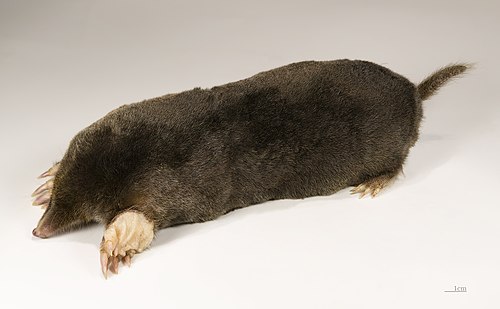


European Mole
Talpa europaea
- KingdomAnimalia (Animals)
- PhylumChordata (Chordates)
- ClassMammalia (Mammals)
- OrderSoricomorpha
- FamilyTalpidae (Moles and Desmans)
- GenusTalpa (Eurasian Moles)
- SpeciesTalpa europaea (European Mole)
About the European Mole
The European mole (Talpa europaea) is a mammal of the order Eulipotyphla. It is also known as the common mole and the northern mole. This mole lives in a tunnel system, which it constantly extends. It uses these tunnels to hunt its prey. Under normal conditions, the displaced earth is pushed to the surface, resulting in the characteristic molehills. It is an omnivore that feeds mainly on earthworms, but also on insects, centipedes and mammals such as rodents and other moles. Its saliva contains toxins which paralyse earthworms in particular.
The Aquitanian mole (T. aquitania) was formerly considered conspecific, but was described as a distinct species in 2017. The European mole has a wide range throughout Europe and westernmost Asia, being found as far north as the United Kingdom and southern Scandinavia, as far south as northern Greece, and as far east as western Siberia. It is the only mole species in most of this range. The Loire River in France was thought to form the western barrier to the species' range, separating it from the Aquitanian mole, but studies indicate that while this is largely true, it is not a strict barrier, as member of either... Wikipedia →
Global Distribution
Where this species is recorded worldwide. Restricted to human observations from 2019 onwards — the same kind of record and the same period the probabilities on this page are built from, so collar-tracking studies, camera-trap arrays and museum specimens are excluded. Around Santa Rosa that removes 5,924 GPS fixes from a handful of tagged jaguars.
where this species is recorded (GBIF density — it tracks where observers go, not how likely a sighting is) · parks where it occurs — tap a pin for the sighting probability there
Parks Where Found
| # | Park | Country | Daily sighting probability |
|---|---|---|---|
| 1 | Białowieża National Park | 🇵🇱 Poland | |
| 2 | Kiskunság National Park | 🇭🇺 Hungary | |
| 3 | Hortobágy National Park | 🇭🇺 Hungary | |
| 4 | Biebrza National Park | 🇵🇱 Poland | |
| 5 | Bavarian Forest National Park | 🇩🇪 Germany | |
| 6 | Tatra National Park | 🇸🇰 Slovakia | |
| 7 | Cairngorms National Park | 🇬🇧 United Kingdom | |
| 8 | Snowdonia National Park | 🇬🇧 United Kingdom | |
| 9 | Fertő-Hanság National Park | 🇭🇺 Hungary | |
| 10 | Hohe Tauern National Park | 🇦🇹 Austria | |
| 11 | Wadden Sea National Park | 🇩🇪 Germany | |
| 12 | Triglav National Park | 🇸🇮 Slovenia | |
| 13 | Mercantour National Park | 🇫🇷 France | |
| 14 | Gauja National Park | 🇱🇻 Latvia | |
| 15 | Plitvice Lakes National Park | 🇭🇷 Croatia | |
| 16 | Cévennes National Park | 🇫🇷 France |