

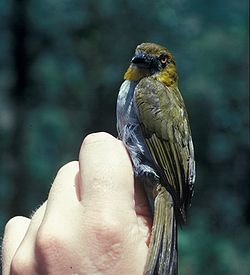


Yellow-throated Bush-Tanager
Chlorospingus flavigularis
Silhouette: L. Shyamal · PhyloPic
- KingdomAnimalia (Animals)
- PhylumChordata (Chordates)
- ClassAves (Birds)
- OrderPasseriformes (Perching Birds)
- FamilyPasserellidae (New World Sparrows)
- GenusChlorospingus (Bush-Tanagers)
- SpeciesChlorospingus flavigularis (Yellow-throated Bush-Tanager)
About the Yellow-throated Bush-Tanager
The yellow-throated chlorospingus or yellow-throated bush tanager (Chlorospingus flavigularis) is a species of bird in the family Passerellidae, the New World sparrows. It is found in Colombia, Ecuador, Panama, and Peru.
The yellow-throated chlorospingus has a complicated taxonomic history. It was formally described in 1852 with the binomial Pipilopsis flavigularis. It was eventually reassigned to genus Chlorospingus that had been erected in 1851. From its description until the early twenty-first century genus Chlorospingus was treated as a member of the family Thraupidae, the "true" tanagers, though its placement within the family was uncertain. Based on studies published in 2002, 2003, and 2007, beginning in 2010 taxonomic systems transferred Chlorospingus to its present sparrow family. The Chlorospingus species were originally called "bush tanagers" or "bush-tanagers". Beginning in 2013 systems began changing the English name of the members of the genus to "chlorospingus" because they were no longer considered tanagers.
The yellow-throated chlorospingus' further taxonomy is unsettled. The American Ornithological Society, the IOC, AviList, the Clements... Wikipedia →
Recent sightings of Yellow-throated Bush-Tanager in Podocarpus National Park
LIVEiNaturalistClosest Relatives at Podocarpus National Park

 Common Chlorospingus
Chlorospingus flavopectus

Ashy-throated Bush-Tanager
Chlorospingus canigularis

Short-billed Bush-Tanager
Chlorospingus parvirostris

Yellow-breasted Brush-Finch
Atlapetes latinuchus

 Rufous-collared Sparrow
Zonotrichia capensis

 Orange-billed Sparrow
Arremon aurantiirostris

 Yellow-browed Sparrow
Ammodramus aurifrons

Chestnut-capped Brushfinch
Arremon brunneinucha

Pale-naped Brush-Finch
Atlapetes pallidinucha

Olive Finch
Arremon castaneiceps

White-winged Brush-Finch
Atlapetes leucopterus

Gray-browed Brushfinch
Arremon assimilis
Global Distribution
Warmer areas are where this animal is recorded most often.
Parks Where Found
| # | Park | Country | Daily sighting probability |
|---|---|---|---|
| 1 | Podocarpus National Park | 🇪🇨 Ecuador | |
| 2 | Farallones de Cali National Natural Park | 🇨🇴 Colombia | |
| 3 | Manu National Park | 🇵🇪 Peru | |
| 4 | Cordillera Azul National Park | 🇵🇪 Peru | |
| 5 | La Amistad International Park (Panama) | 🇵🇦 Panama | |
| 6 | Los Nevados National Natural Park | 🇨🇴 Colombia | |
| 7 | Chingaza National Natural Park | 🇨🇴 Colombia | |
| 8 | Puracé National Natural Park | 🇨🇴 Colombia | |
| 9 | Sierra de la Macarena National Park | 🇨🇴 Colombia |
Quick answers
What are the chances of seeing a Yellow-throated Bush-Tanager in Podocarpus National Park?
About 30% of wildlife watchers report a Yellow-throated Bush-Tanager sighting in Podocarpus National Park, based on 466 verified sightings from GBIF citizen-science data.
When is the best time to see Yellow-throated Bush-Tanager in Podocarpus National Park?
May has the highest sighting rate for Yellow-throated Bush-Tanager in Podocarpus National Park in our monthly data.