
Greater Sandplover
Charadrius leschenaultii
- KingdomAnimalia (Animals)
- PhylumChordata (Chordates)
- ClassAves (Birds)
- OrderCharadriiformes (Shorebirds and Allies)
- FamilyCharadriidae (Plovers and Lapwings)
- GenusCharadrius (Holarctic Ringed Plovers and Allies)
- SpeciesCharadrius leschenaultii (Greater Sandplover)
About the Greater Sandplover
The greater sand plover (Anarhynchus leschenaultii) is a small wader in the plover family of birds. The spelling is often given as "greater sandplover" or "greater sand-plover", but the official IOC and British Ornithologists' Union spelling is "Greater Sand Plover". The specific leschenaultii commemorates the French botanist Jean Baptiste Leschenault de la Tour. Like most other species in the genus Anarhynchus, it was until recently included in the genus Charadrius.
It breeds in the semi-deserts of Turkey and eastwards through Central Asia, where it nests in a bare ground scrape. This species is strongly migratory, wintering on sandy beaches in East Africa, South Asia and Australasia. It is a rare vagrant in western Europe, where it has been recorded as far west as Iceland. It has been recorded three times in North America, the most recent being on 13 April 2025 in Biscay Bay, Newfoundland and Labrador. Last previous sighing in NA,14 May 2009 in Jacksonville, Florida.
There are three subspecies: A. l. leschenaultii, the nominate, in the east of the species' range in Mongolia and NW China. Bill intermediate; summer plumage with a weak orange breast... Wikipedia →
Closest Relatives at Raja Ampat

Eastern Sand Plover
Charadrius veredus

Pacific Golden-Plover
Pluvialis fulva

Black-bellied Plover
Pluvialis squatarola
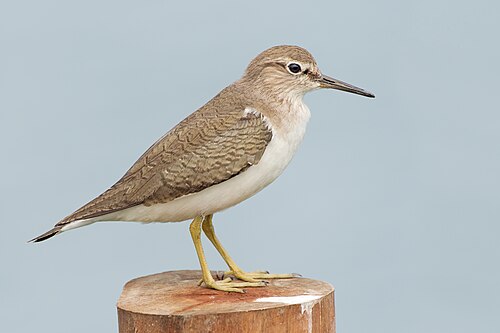
Common Sandpiper
Actitis hypoleucos

Crested Tern
Thalasseus bergii

Whimbrel
Numenius phaeopus

Common Tern
Sterna hirundo

Bridled Tern
Onychoprion anaethetus

Red-necked Phalarope
Phalaropus lobatus

Black-naped Tern
Sterna sumatrana

Grey-tailed Tattler
Tringa brevipes

Great Knot
Calidris tenuirostris
Global Distribution
Where this species is recorded worldwide. Restricted to human observations from 2019 onwards — the same kind of record and the same period the probabilities on this page are built from, so collar-tracking studies, camera-trap arrays and museum specimens are excluded. Around Santa Rosa that removes 5,924 GPS fixes from a handful of tagged jaguars.
where this species is recorded (GBIF density — it tracks where observers go, not how likely a sighting is) · parks where it occurs — tap a pin for the sighting probability there
Parks Where Found
| # | Park | Country | Daily sighting probability |
|---|---|---|---|
| 1 | Sundarbans National Park | 🇮🇳 India | |
| 2 | Cape Range | 🇦🇺 Australia | |
| 3 | Ningaloo Marine Park | 🇦🇺 Australia | |
| 4 | Tsavo East National Park | 🇰🇪 Kenya | |
| 5 | Yala National Park | 🇱🇰 Sri Lanka | |
| 6 | Gobi Gurvansaikhan National Park | 🇲🇳 Mongolia | |
| 7 | Bali Barat National Park | 🇮🇩 Indonesia | |
| 8 | Daintree National Park | 🇦🇺 Australia | |
| 9 | Raja Ampat | 🇮🇩 Indonesia | |
| 10 | Taroko National Park | 🇹🇼 Taiwan | |
| 11 | Kiskunság National Park | 🇭🇺 Hungary | |
| 12 | Addo Elephant National Park | 🇿🇦 South Africa | |
| 13 | Bako National Park | 🇲🇾 Malaysia | |
| 14 | Wilpattu National Park | 🇱🇰 Sri Lanka | |
| 15 | iSimangaliso Wetland Park | 🇿🇦 South Africa | |
| 16 | Tarangire National Park | 🇹🇿 Tanzania | |
| 17 | Garden Route National Park | 🇿🇦 South Africa | |
| 18 | Kaeng Krachan National Park | 🇹🇭 Thailand | |
| 19 | Ngorongoro Conservation Area | 🇹🇿 Tanzania | |
| 20 | Namib-Naukluft National Park | 🇳🇦 Namibia | |
| 21 | Serengeti National Park | 🇹🇿 Tanzania | |
| 22 | Wadden Sea National Park | 🇩🇪 Germany |
Quick answers
What are the chances of seeing a Greater Sandplover in Raja Ampat?
Under 5% of wildlife watchers report a Greater Sandplover sighting in Raja Ampat, based on 24 verified sightings from GBIF citizen-science data.
When is the best time to see Greater Sandplover in Raja Ampat?
March has the highest sighting rate for Greater Sandplover in Raja Ampat in our monthly data.