
Long-tailed Jaeger
Stercorarius longicaudus
- KingdomAnimalia (Animals)
- PhylumChordata (Chordates)
- ClassAves (Birds)
- OrderCharadriiformes (Shorebirds and Allies)
- FamilyStercorariidae (Skuas and Jaegers)
- GenusStercorarius (Skuas and Jaegers)
- SpeciesStercorarius longicaudus (Long-tailed Jaeger)
About the Long-tailed Jaeger
The long-tailed jaeger or long-tailed skua (Stercorarius longicaudus) is a seabird in the skua family Stercorariidae. The word "jaeger" is derived from the German word Jäger, meaning "hunter". The English word "skua" comes from the Faroese name skúgvur [ˈskɪkvʊər] for the great skua, with the island of Skúvoy known for its colony of that bird. The general Faroese term for skuas is kjógvi [ˈtʃɛkvə]. The genus name Stercorarius is Latin and means "of dung"; the food disgorged by other birds when pursued by skuas was once thought to be excrement. The specific longicaudus is from Latin longus, "long", and cauda, "tail".
This species is unmistakable as an adult, with grey back, dark primary wing feathers without a white "flash", black cap and very long tail. Adults often hover over their breeding territories. Juveniles are much more problematic, and are difficult to separate from parasitic jaeger over the sea. They are slimmer, longer-winged and more tern-like than that species, but show the same wide range of plumage variation. However, they are usually colder toned than Arctic, with greyer shades, rather than brown.
This is the smallest of the skua family... Wikipedia →
Closest Relatives at Raja Ampat

Pomarine Jaeger
Stercorarius pomarinus
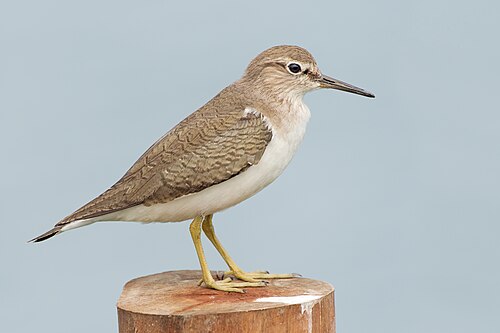
Common Sandpiper
Actitis hypoleucos

Crested Tern
Thalasseus bergii

Whimbrel
Numenius phaeopus

Common Tern
Sterna hirundo

Pacific Golden-Plover
Pluvialis fulva

Bridled Tern
Onychoprion anaethetus

Red-necked Phalarope
Phalaropus lobatus

Black-naped Tern
Sterna sumatrana

Grey-tailed Tattler
Tringa brevipes

Great Knot
Calidris tenuirostris

Curlew Sandpiper
Calidris ferruginea
Global Distribution
Where this species is recorded worldwide. Restricted to human observations from 2019 onwards — the same kind of record and the same period the probabilities on this page are built from, so collar-tracking studies, camera-trap arrays and museum specimens are excluded. Around Santa Rosa that removes 5,924 GPS fixes from a handful of tagged jaguars.
where this species is recorded (GBIF density — it tracks where observers go, not how likely a sighting is) · parks where it occurs — tap a pin for the sighting probability there
Parks Where Found
| # | Park | Country | Daily sighting probability |
|---|---|---|---|
| 1 | Channel Islands National Park | 🇺🇸 United States | |
| 2 | Denali National Park | 🇺🇸 United States | |
| 3 | Cabo Blanco Absolute Nature Reserve | 🇨🇷 Costa Rica | |
| 4 | Raja Ampat | 🇮🇩 Indonesia | |
| 5 | Fiordland National Park | 🇳🇿 New Zealand | |
| 6 | Death Valley National Park | 🇺🇸 United States | |
| 7 | Wadden Sea National Park | 🇩🇪 Germany | |
| 8 | Point Pelee National Park | 🇨🇦 Canada | |
| 9 | Olympic National Park | 🇺🇸 United States | |
| 10 | Great Bear Rainforest | 🇨🇦 Canada | |
| 11 | Gates of the Arctic National Park | 🇺🇸 United States | |
| 12 | Paracas National Reserve | 🇵🇪 Peru | |
| 13 | Katmai National Park | 🇺🇸 United States | |
| 14 | Kenai Fjords National Park | 🇺🇸 United States | |
| 15 | Biebrza National Park | 🇵🇱 Poland | |
| 16 | Wrangell-St. Elias National Park | 🇺🇸 United States | |
| 17 | Pacific Rim National Park Reserve | 🇨🇦 Canada | |
| 18 | Redwood National Park | 🇺🇸 United States | |
| 19 | Vatnajokull National Park | 🇮🇸 Iceland |
Quick answers
What are the chances of seeing a Long-tailed Jaeger in Raja Ampat?
Under 5% of wildlife watchers report a Long-tailed Jaeger sighting in Raja Ampat, based on 5 verified sightings from GBIF citizen-science data.
When is the best time to see Long-tailed Jaeger in Raja Ampat?
March has the highest sighting rate for Long-tailed Jaeger in Raja Ampat in our monthly data.