


Oceanic Manta Ray
Mobula birostris
- KingdomAnimalia (Animals)
- PhylumChordata (Chordates)
- ClassElasmobranchii
- OrderMyliobatiformes (Stingrays)
- FamilyMyliobatidae (Eagle Rays)
- GenusMobula (Devil Rays)
- SpeciesMobula birostris (Oceanic Manta Ray)
About the Oceanic Manta Ray
The giant oceanic manta ray, giant manta ray, oceanic manta ray, or pelagic manta ray (Mobula birostris) is a species of ray in the family Mobulidae and the largest type of ray in the world. It is circumglobal and is typically found in tropical and subtropical waters but can also be found in temperate waters. Until 2017, the species was classified in the genus Manta, along with the smaller reef manta ray (Mobula alfredi). DNA testing revealed that both mantas are closer related to some Mobula species than these are to other Mobula, being claded together. As a result, the two Manta species were absorbed into Mobula to reflect the new classification.
The giant oceanic manta ray has a widespread distribution in tropical and temperate waters worldwide. In the Northern Hemisphere, it has been recorded as far north as southern California and New Jersey in the United States, Aomori Prefecture in Japan, the Sinai Peninsula in Egypt, and the Azores in the northern Atlantic. In the Southern Hemisphere, it occurs as far south as Peru, Uruguay, South Africa, and New Zealand.
It is an ocean-going species and spends most of its life far from land, travelling with the... Wikipedia →
Closest Relatives at Raja Ampat

Munguna
Mobula alfredi

Ox Ray
Mobula kuhlii

Longhorned Pygmy Devil Ray
Mobula eregoodoo

White-spotted Eagle Ray
Aetobatus ocellatus

Ornate Eagle Ray
Aetomylaeus vespertilio
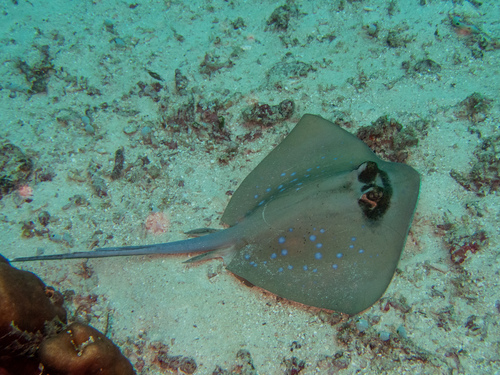
Moluccan Bluespotted Maskray
Neotrygon moluccensis

Reef ray
Taeniura lymma

Mangrove Ray
Urogymnus granulatus

Blotched Fantail Ray
Taeniurops meyeni

Oriental Bluespotted Maskray
Neotrygon orientale

Reticulate Whipray
Himantura uarnak

Pink Whipray
Pateobatis fai
Global Distribution
Where this species is recorded worldwide. Restricted to human observations from 2019 onwards — the same kind of record and the same period the probabilities on this page are built from, so collar-tracking studies, camera-trap arrays and museum specimens are excluded. Around Santa Rosa that removes 5,924 GPS fixes from a handful of tagged jaguars.
where this species is recorded (GBIF density — it tracks where observers go, not how likely a sighting is) · parks where it occurs — tap a pin for the sighting probability there
Parks Where Found
| # | Park | Country | Daily sighting probability |
|---|---|---|---|
| 1 | Raja Ampat | 🇮🇩 Indonesia | |
| 2 | Galápagos Islands | 🇪🇨 Ecuador | |
| 3 | Isla del Coco National Park | 🇨🇷 Costa Rica | |
| 4 | Coiba National Park | 🇵🇦 Panama | |
| 5 | Machalilla National Park | 🇪🇨 Ecuador | |
| 6 | Ningaloo Marine Park | 🇦🇺 Australia |
Quick answers
What are the chances of seeing a Oceanic Manta Ray in Raja Ampat?
About 40% of wildlife watchers report a Oceanic Manta Ray sighting in Raja Ampat, based on 30 verified sightings from GBIF citizen-science data.
When is the best time to see Oceanic Manta Ray in Raja Ampat?
March has the highest sighting rate for Oceanic Manta Ray in Raja Ampat in our monthly data.