



Rainbow Skink
Lampropholis delicata
Silhouette: Michael Scroggie · PhyloPic
- KingdomAnimalia (Animals)
- PhylumChordata (Chordates)
- ClassSquamata
- FamilyScincidae (Skinks)
- GenusLampropholis (Australian Sunskinks)
- SpeciesLampropholis delicata (Rainbow Skink)
About the Rainbow Skink
Lampropholis delicata, the delicate skink, dark-flecked garden sun skink, garden skink, delicate garden skink, rainbow skink or plague skink, or the metallic skink is native to Australia and invasive in New Zealand and Hawaii where it is commonly found in gardens. The species is known for their color dimorphism between males and females; striped morphs and non-striped morphs exist in this species, however the stripe is less pronounced in males. This species' diet consists of a wide range of prey, such as spiders, bees, larvae, and termites. Mating occurs in the late summer and generally one clutch of 2 to 4 eggs are laid per year by each female.
The delicate skink is more common in suburban gardens than in adjacent native bushland. It has a moderate body with a medium length, slender tail. Its scales are smooth. The back and sides are greyish-brown to rich brown, often with darker and paler flecks. A narrow yellowish-brown stripe is usually present on the outer edge of the back. The species can also have two distinct forms: a prominent white stripe and a less prominent white stripe. This dimorphism is not strictly distinguished by gender.
Lampropholis... Wikipedia →
Recent sightings of Rainbow Skink in Royal National Park
LIVEiNaturalistClosest Relatives at Royal National Park

 Pale-flecked Garden Sunskink
Lampropholis guichenoti

 Eastern Water Skink
Eulamprus quoyii

Copper-tailed Ctenotus
Ctenotus taeniolatus

Common Bluetongue
Tiliqua scincoides

 Cunningham's Skink
Egernia cunninghami

Yellow-bellied Three-toed Skink
Saiphos equalis

Elegant Snake-eyed Skink
Cryptoblepharus pulcher

Southern Weasel Skink
Saproscincus mustelinus
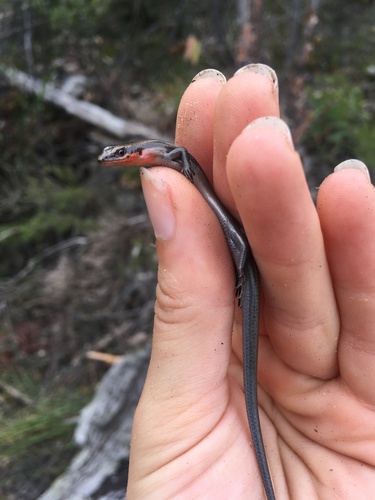
Red-throated Cool-skink
Acritoscincus platynotus

Bar-sided Skink
Concinnia tenuis

Gully Shadeskink
Saproscincus spectabilis

 Coastal She-oak Slender Bluetongue
Cyclodomorphus michaeli
Global Distribution
Warmer areas are where this animal is recorded most often.
Parks Where Found
| # | Park | Country | Daily sighting probability |
|---|---|---|---|
| 1 | Blue Mountains National Park | 🇦🇺 Australia | |
| 2 | Lamington National Park | 🇦🇺 Australia | |
| 3 | Royal National Park | 🇦🇺 Australia | |
| 4 | Springbrook National Park | 🇦🇺 Australia | |
| 5 | Noosa National Park | 🇦🇺 Australia | |
| 6 | Kosciuszko National Park | 🇦🇺 Australia | |
| 7 | Booderee National Park | 🇦🇺 Australia | |
| 8 | Maria Island National Park | 🇦🇺 Australia | |
| 9 | Freycinet National Park | 🇦🇺 Australia | |
| 10 | Great Otway National Park | 🇦🇺 Australia |
Quick answers
What are the chances of seeing a Rainbow Skink in Royal National Park?
About 10% of wildlife watchers report a Rainbow Skink sighting in Royal National Park, based on 20 verified sightings from GBIF citizen-science data.
When is the best time to see Rainbow Skink in Royal National Park?
March has the highest sighting rate for Rainbow Skink in Royal National Park in our monthly data.