
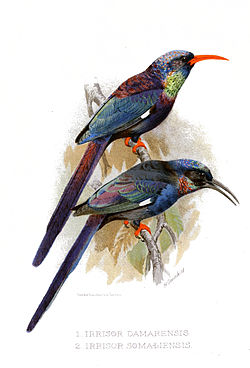


Violet Wood Hoopoe
Phoeniculus damarensis
Silhouette: Jon Hill (Photo by DickDaniels: http://en.wikipedia.org/wiki/File:Green_Woodhoopoe_RWD7.jpg) · PhyloPic
- KingdomAnimalia (Animals)
- PhylumChordata (Chordates)
- ClassAves (Birds)
- OrderBucerotiformes (Hornbills and Hoopoes)
- FamilyPhoeniculidae (Woodhoopoes and Scimitarbills)
- GenusPhoeniculus (Woodhoopoes)
- SpeciesPhoeniculus damarensis (Violet Wood Hoopoe)
About the Violet Wood Hoopoe
The violet wood hoopoe (Phoeniculus damarensis) is a species of bird in the family Phoeniculidae. It is found in Angola, Kenya, Namibia, and Tanzania. It looks similar to the black-billed wood hoopoe but with a red beak and a green throat. It has coppery and violet mantle feathers.
The violet wood hoopoe was formally described in 1901 by the Scottish ornithologist William Robert Ogilvie-Grant under the binomial name Irrisor damarensis. The specific epithet is from Damaraland in Namibia. The violet wood hoopoe is now one of five species placed in the genus Phoeniculus that was introduced in 1821 by the Polish zoologist Feliks Paweł Jarocki.
Two subspecies are recognised: P. d. damarensis (Ogilvie-Grant, 1901) – Angola and Namibia P. d. granti (Neumann, 1903) – central, southeast Kenya The subspecies P. d. granti has sometimes been considered as a separate species as its distribution is separated by a very large distance from that of the nominate race.
The violet wood hoopoe was formerly considered to be conspecific with the green wood hoopoe (Phoeniculus purpureus). It has been argued that the violet wood hoopoe should be considered as a distinct species because of its... Wikipedia →
Recent sightings of Violet Wood Hoopoe in Samburu National Reserve
LIVEiNaturalistClosest Relatives at Samburu National Reserve

 Green Wood Hoopoe
Phoeniculus purpureus

 Abyssinian Scimitarbill
Rhinopomastus minor

Common Scimitarbill
Rhinopomastus cyanomelas

 Northern Red-billed Hornbill
Tockus erythrorhynchus

Von der Decken's Hornbill
Tockus deckeni

Eastern Yellow-billed Hornbill
Tockus flavirostris

 Common Hoopoe
Upupa epops
African Hoopoe
Upupa africana

 African Grey Hornbill
Lophoceros nasutus
Global Distribution
Warmer areas are where this animal is recorded most often.
Parks Where Found
| # | Park | Country | Daily sighting probability |
|---|---|---|---|
| 1 | Meru National Park | 🇰🇪 Kenya | |
| 2 | Etosha National Park | 🇳🇦 Namibia | |
| 3 | Samburu National Reserve | 🇰🇪 Kenya | |
| 4 | Waterberg Plateau Park | 🇳🇦 Namibia | |
| 5 | Nairobi National Park | 🇰🇪 Kenya | |
| 6 | Tsavo West National Park | 🇰🇪 Kenya | |
| 7 | Tsavo East National Park | 🇰🇪 Kenya | |
| 8 | Namib-Naukluft National Park | 🇳🇦 Namibia |
Quick answers
What are the chances of seeing a Violet Wood Hoopoe in Samburu National Reserve?
About 10% of wildlife watchers report a Violet Wood Hoopoe sighting in Samburu National Reserve, based on 88 verified sightings from GBIF citizen-science data.
When is the best time to see Violet Wood Hoopoe in Samburu National Reserve?
April has the highest sighting rate for Violet Wood Hoopoe in Samburu National Reserve in our monthly data.