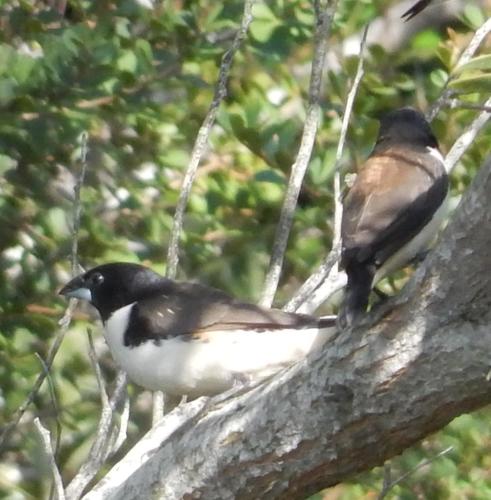
Magpie Mannikin
Lonchura fringilloides
Silhouette: Ferran Sayol · PhyloPic
- KingdomAnimalia (Animals)
- PhylumChordata (Chordates)
- ClassAves (Birds)
- OrderPasseriformes (Perching Birds)
- FamilyEstrildidae (Waxbills and Allies)
- GenusLonchura (Typical Munias and Mannikins)
- SpeciesLonchura fringilloides (Magpie Mannikin)
About the Magpie Mannikin
The magpie mannikin or magpie munia (Spermestes fringilloides) is a species of estrildid finch, sparsely present across Sub-Saharan Africa. It has an estimated global extent of occurrence of 1,400,000 km2. It is found in subtropical/ tropical (lowland) moist shrubland, forest and dry grassland habitat. The status of the species is evaluated as Least Concern.
BirdLife Species Factsheet Magpie mannikin - Species text in The Atlas of Southern African Birds. Wikipedia →
Recent sightings of Magpie Mannikin in Semuliki National Park
LIVEiNaturalistClosest Relatives at Semuliki National Park

 Bronze Mannikin
Lonchura cucullata

Black-and-white Mannikin
Lonchura bicolor

 Chestnut-breasted Negrofinch
Nigrita bicolor

Gray-headed Negrofinch
Nigrita canicapillus

 Orange-cheeked Waxbill
Estrilda melpoda

White-breasted Negrofinch
Nigrita fusconotus

Red-headed Bluebill
Spermophaga ruficapilla

Black-crowned Waxbill
Estrilda nonnula

Grant's Bluebill
Spermophaga poliogenys

Black-bellied Seedcracker
Pyrenestes ostrinus

Fawn-breasted Waxbill
Estrilda paludicola

Pale-fronted Negrofinch
Nigrita luteifrons
Global Distribution
Warmer areas are where this animal is recorded most often.
Parks Where Found
| # | Park | Country | Daily sighting probability |
|---|---|---|---|
| 1 | Kibale National Park | 🇺🇬 Uganda | |
| 2 | Semuliki National Park | 🇺🇬 Uganda | |
| 3 | Bwindi Impenetrable National Park | 🇺🇬 Uganda | |
| 4 | Virunga National Park | 🇨🇩 Democratic Republic of the Congo | |
| 5 | Addo Elephant National Park | 🇿🇦 South Africa | |
| 6 | iSimangaliso Wetland Park | 🇿🇦 South Africa | |
| 7 | Liwonde National Park | 🇲🇼 Malawi | |
| 8 | Murchison Falls National Park | 🇺🇬 Uganda | |
| 9 | Queen Elizabeth National Park | 🇺🇬 Uganda | |
| 10 | Ngorongoro Conservation Area | 🇹🇿 Tanzania | |
| 11 | Kruger National Park | 🇿🇦 South Africa |
Quick answers
What are the chances of seeing a Magpie Mannikin in Semuliki National Park?
Under 5% of wildlife watchers report a Magpie Mannikin sighting in Semuliki National Park, based on 18 verified sightings from GBIF citizen-science data.
When is the best time to see Magpie Mannikin in Semuliki National Park?
December has the highest sighting rate for Magpie Mannikin in Semuliki National Park in our monthly data.