

Red-headed Bluebill
Spermophaga ruficapilla
Silhouette: Sheatherius · PhyloPic
- KingdomAnimalia (Animals)
- PhylumChordata (Chordates)
- ClassAves (Birds)
- OrderPasseriformes (Perching Birds)
- FamilyEstrildidae (Waxbills and Allies)
- GenusSpermophaga (Bluebills)
- SpeciesSpermophaga ruficapilla (Red-headed Bluebill)
About the Red-headed Bluebill
The red-headed bluebill (Spermophaga ruficapilla) is a common species of estrildid finch found in Sub-Saharan Africa. It is found in Angola, Burundi, Central African Republic, The Democratic Republic of the Congo, Kenya, Rwanda, South Sudan, Tanzania and Uganda.
This species has a large range, with an estimated global extent of occurrence of 560,000 km2. The global population size has not been quantified, but it is believed to be large as the species is described as "frequent" in at least parts of its range (Fry and Keith 2004). Global population trends have not been quantified, but the species is not believed to approach the thresholds for the population decline criterion of the IUCN Red List (i.e. declining more than 30% in ten years or three generations). For these reasons, the species is evaluated as being of least concern.[1]
BirdLife International species factsheet Wikipedia →
Recent sightings of Red-headed Bluebill in Semuliki National Park
LIVEiNaturalistClosest Relatives at Semuliki National Park

 Grant's Bluebill
Spermophaga poliogenys

 Bronze Mannikin
Lonchura cucullata

Chestnut-breasted Negrofinch
Nigrita bicolor

Gray-headed Negrofinch
Nigrita canicapillus

 Orange-cheeked Waxbill
Estrilda melpoda

White-breasted Negrofinch
Nigrita fusconotus

Black-and-white Mannikin
Lonchura bicolor

Black-crowned Waxbill
Estrilda nonnula

Black-bellied Seedcracker
Pyrenestes ostrinus

Fawn-breasted Waxbill
Estrilda paludicola
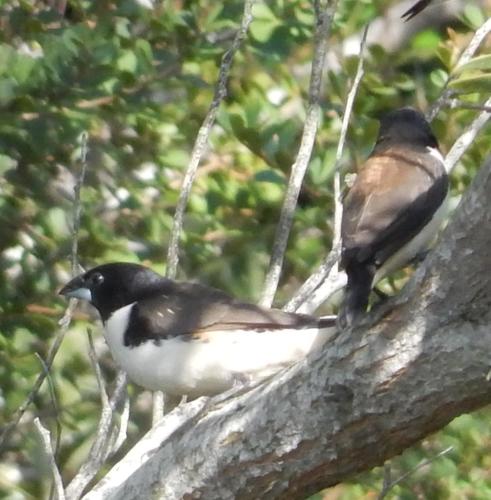
Magpie Mannikin
Lonchura fringilloides

Pale-fronted Negrofinch
Nigrita luteifrons
Global Distribution
Warmer areas are where this animal is recorded most often.
Parks Where Found
| # | Park | Country | Daily sighting probability |
|---|---|---|---|
| 1 | Semuliki National Park | 🇺🇬 Uganda | |
| 2 | Kibale National Park | 🇺🇬 Uganda | |
| 3 | Bwindi Impenetrable National Park | 🇺🇬 Uganda | |
| 4 | Virunga National Park | 🇨🇩 Democratic Republic of the Congo | |
| 5 | Queen Elizabeth National Park | 🇺🇬 Uganda | |
| 6 | Kidepo Valley National Park | 🇺🇬 Uganda | |
| 7 | Akagera National Park | 🇷🇼 Rwanda | |
| 8 | Murchison Falls National Park | 🇺🇬 Uganda | |
| 9 | Volcanoes National Park | 🇷🇼 Rwanda | |
| 10 | Nyungwe National Park | 🇷🇼 Rwanda |
Quick answers
What are the chances of seeing a Red-headed Bluebill in Semuliki National Park?
About 20% of wildlife watchers report a Red-headed Bluebill sighting in Semuliki National Park, based on 74 verified sightings from GBIF citizen-science data.
When is the best time to see Red-headed Bluebill in Semuliki National Park?
December has the highest sighting rate for Red-headed Bluebill in Semuliki National Park in our monthly data.