
Asian Blue Quail
Synoicus chinensis
- KingdomAnimalia (Animals)
- PhylumChordata (Chordates)
- ClassAves (Birds)
- OrderGalliformes (Landfowl)
- FamilyPhasianidae (Pheasants, Grouse, and Allies)
- GenusSynoicus (Blue and Brown Quails)
- SpeciesSynoicus chinensis (Asian Blue Quail)
About the Asian Blue Quail
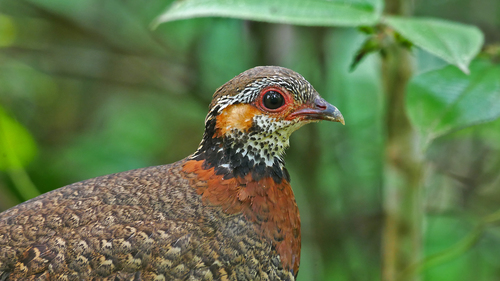
The king quail (Synoicus chinensis), also known as the Asian blue quail, blue-breasted quail, Chinese painted quail, button quail, or Chung-Chi, is a very small, diminutive galliform of the tribe Coturnicini in the subfamily Phasianinae. They are the smallest member in this subfamily and the family Phasianidae, as well as being the smallest and lightest member of the order Galliformes. It is quite common in aviculture worldwide, where it is sometimes referred to as the "button quail", although it is not closely related to the family of birds called buttonquails. Its voice is a piping whistle, ti-yu or ti-ti-yu. It also gives sharp cheeps or a tir-tir-tir sound when flushed.
King quail is 12–15 cm long, with a wingspan of about 25 cm long, and weighing 20–57 g. Males are distinctive, with a dark brown back and wings, dark blue-grey flanks and neck, and dark red-brown underparts; the face is patterned with a black chin with a white band just below on the upper throat, and black and white stripes below the eyes. Females are much plainer rufous-brown all over except for a paler belly.
They range in the wild from southern China, South and... Wikipedia →


Global Distribution
Where this species is recorded worldwide. Restricted to human observations from 2019 onwards — the same kind of record and the same period the probabilities on this page are built from, so collar-tracking studies, camera-trap arrays and museum specimens are excluded. Around Santa Rosa that removes 5,924 GPS fixes from a handful of tagged jaguars.
where this species is recorded (GBIF density — it tracks where observers go, not how likely a sighting is) · parks where it occurs — tap a pin for the sighting probability there
Parks Where Found
| # | Park | Country | Daily sighting probability |
|---|---|---|---|
| 1 | Manas National Park | 🇮🇳 India | |
| 2 | Yala National Park | 🇱🇰 Sri Lanka | |
| 3 | Table Mountain National Park | 🇿🇦 South Africa | |
| 4 | Gunung Leuser National Park | 🇮🇩 Indonesia | |
| 5 | Minneriya National Park | 🇱🇰 Sri Lanka | |
| 6 | Tangkoko Nature Reserve | 🇮🇩 Indonesia | |
| 7 | Bali Barat National Park | 🇮🇩 Indonesia | |
| 8 | Wilpattu National Park | 🇱🇰 Sri Lanka | |
| 9 | Royal Manas National Park | 🇧🇹 Bhutan | |
| 10 | Khao Luang National Park | 🇹🇭 Thailand | |
| 11 | Cat Tien National Park | 🇻🇳 Vietnam | |
| 12 | Khao Yai National Park | 🇹🇭 Thailand | |
| 13 | Royal National Park | 🇦🇺 Australia | |
| 14 | Kaeng Krachan National Park | 🇹🇭 Thailand | |
| 15 | Sepilok | 🇲🇾 Malaysia | |
| 16 | Blue Mountains National Park | 🇦🇺 Australia | |
| 17 | Kinabalu Park | 🇲🇾 Malaysia |