


Asian Painted Frog
Kaloula pulchra
- KingdomAnimalia (Animals)
- PhylumChordata (Chordates)
- ClassAmphibia (Amphibians)
- OrderAnura (Frogs and Toads)
- FamilyMicrohylidae (Narrow-mouthed Frogs)
- GenusKaloula (Asian Narrowmouth Frogs)
- SpeciesKaloula pulchra (Asian Painted Frog)
About the Asian Painted Frog
The banded bullfrog (Kaloula pulchra) is a species of frog in the narrow-mouthed frog family Microhylidae. Native to Southeast Asia, it is also known as the Asian painted frog, digging frog, Malaysian bullfrog, common Asian frog, and painted balloon frog. In the pet trade, it is sometimes called the chubby frog. Adults measure 5.4 to 7.5 cm (2.1 to 3.0 in) and have a dark brown back with stripes that vary from copper-brown to salmon pink.
The banded bullfrog lives at low altitudes and is found in both urban and rural settings, as well as in forest habitats. They bury themselves underground during dry periods and emerge after heavy rainfall to emit calls and breed. They feed primarily on ants and termites; predators of adults and tadpoles include snakes, dragonfly larvae, and snails. When threatened, they inflate their lungs and secrete a noxious white substance. The species is prevalent in the pet trade and is a potential invasive species being introduced in Taiwan, the Philippines, Guam, Singapore, Borneo, and Sulawesi.
The banded bullfrog was first described in 1831 by the British zoologist John Edward Gray, as Kaloula pulchra (pulchra meaning "beautiful... Wikipedia →
Closest Relatives at Sepilok

Smooth-Fingered Narrow-mouthed Frog
Kaloula baleata
_Figure_3_(cropped).jpg)
Bornean Sticky Frog
Kalophrynus meizon

Tree Hole Frog
Metaphrynella sundana

Yellow-spotted Narrow-mouthed Frog
Chaperina fusca
Mengiong Sticky Frog
Kalophrynus intermedius
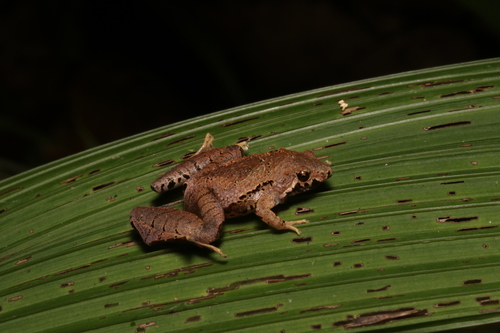
Bornean Narrow-mouthed Frog
Microhyla malang

Common Indian Toad
Duttaphrynus melanostictus

Rough-sided frog
Pulchrana glandulosa

Brown-Striped Tree Frog
Polypedates macrotis

Green Paddy Frog
Hylarana erythraea

File-eared Tree Frog
Polypedates otilophus

Lowland Litter Frog
Leptobrachium abbotti
Global Distribution
Where this species is recorded worldwide. Restricted to human observations from 2019 onwards — the same kind of record and the same period the probabilities on this page are built from, so collar-tracking studies, camera-trap arrays and museum specimens are excluded. Around Santa Rosa that removes 5,924 GPS fixes from a handful of tagged jaguars.
where this species is recorded (GBIF density — it tracks where observers go, not how likely a sighting is) · parks where it occurs — tap a pin for the sighting probability there
Parks Where Found
| # | Park | Country | Daily sighting probability |
|---|---|---|---|
| 1 | Way Kambas National Park | 🇮🇩 Indonesia | |
| 2 | Khao Sok National Park | 🇹🇭 Thailand | |
| 3 | Cat Tien National Park | 🇻🇳 Vietnam | |
| 4 | Taman Negara National Park | 🇲🇾 Malaysia | |
| 5 | Kaeng Krachan National Park | 🇹🇭 Thailand | |
| 6 | Khao Yai National Park | 🇹🇭 Thailand | |
| 7 | Cuc Phuong National Park | 🇻🇳 Vietnam | |
| 8 | Kerinci Seblat National Park | 🇮🇩 Indonesia | |
| 9 | Khao Luang National Park | 🇹🇭 Thailand | |
| 10 | Sepilok | 🇲🇾 Malaysia | |
| 11 | Gunung Leuser National Park | 🇮🇩 Indonesia |