


Olive Dasia
Dasia olivacea
- KingdomAnimalia (Animals)
- PhylumChordata (Chordates)
- ClassSquamata
- FamilyScincidae (Skinks)
- GenusDasia (Dasia Skinks)
- SpeciesDasia olivacea (Olive Dasia)
About the Olive Dasia
Dasia olivacea, the olive dasia or olive tree skink, is a semi-arboreal species of skink lizard native to Southeast Asia. Dasia olivacea is found south of approximately 15° north in Southeast Asia, including parts of Laos, Malaysia, Myanmar, Thailand, Singapore, Vietnam, throughout the island of Borneo (Sarawak, Kalimantan, Brunei), the Indonesian islands of Bali, Java and Sumatra (among others), as well as India's Andaman and Nicobar Islands.
The species is originally known from a single locality in Cambodia. The northernmost extreme for D. olivacea is possibly the Sakaerat Environmental Research Station in the Nakhon Ratchasima Province of eastern Thailand. Dasia olivacea lives almost exclusively in trees, only rarely descending to nest or to move between trees. Eggs may be laid more than once per year, in clutches of up to 14 eggs; incubation lasts 69 days. Because it is very widespread and ecologically flexible, D. olivacea is considered to be a species of Least Concern on the IUCN Red List.
Dasia olivacea was first described by John Edward Gray, in a publication of the Annals of Natural History (1839), as the type... Wikipedia →
Closest Relatives at Sepilok

Borneo Skink
Dasia vittata

Rough Mabuya
Eutropis rudis

Sabah Slender Skink
Sphenomorphus sabanus

Lewis's mabuya
Eutropis lewisi

Many-lined Sun-skink
Eutropis multifasciata

Rough-scaled Sun Skink
Eutropis rugifera
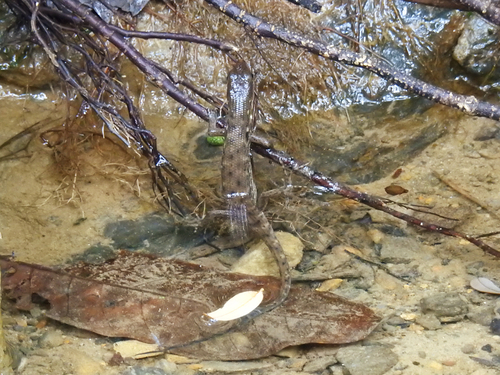
Brook’s Keeled Skink
Tropidophorus brookei
Lipinia inexpectata
Lipinia inexpectata

Littoral Whiptail-skink
Emoia atrocostata

Brown's Mabuya
Eutropis indeprensa

Bowring’s Supple Skink
Subdoluseps bowringii

Sarawak Forest Skink
Sphenomorphus haasi
Global Distribution
Where this species is recorded worldwide. Restricted to human observations from 2019 onwards — the same kind of record and the same period the probabilities on this page are built from, so collar-tracking studies, camera-trap arrays and museum specimens are excluded. Around Santa Rosa that removes 5,924 GPS fixes from a handful of tagged jaguars.
where this species is recorded (GBIF density — it tracks where observers go, not how likely a sighting is) · parks where it occurs — tap a pin for the sighting probability there
Parks Where Found
| # | Park | Country | Daily sighting probability |
|---|---|---|---|
| 1 | Khao Sok National Park | 🇹🇭 Thailand | |
| 2 | Kaeng Krachan National Park | 🇹🇭 Thailand | |
| 3 | Gunung Leuser National Park | 🇮🇩 Indonesia | |
| 4 | Cat Tien National Park | 🇻🇳 Vietnam | |
| 5 | Khao Yai National Park | 🇹🇭 Thailand | |
| 6 | Bako National Park | 🇲🇾 Malaysia | |
| 7 | Kerinci Seblat National Park | 🇮🇩 Indonesia | |
| 8 | Taman Negara National Park | 🇲🇾 Malaysia | |
| 9 | Sepilok | 🇲🇾 Malaysia |