

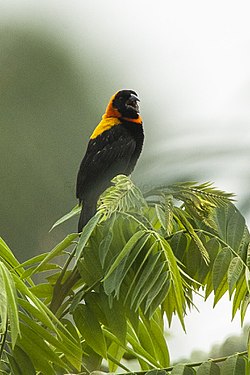
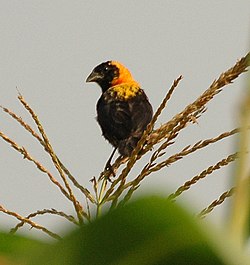

Black Bishop
Euplectes gierowii
Silhouette: Sheatherius · PhyloPic
- KingdomAnimalia (Animals)
- PhylumChordata (Chordates)
- ClassAves (Birds)
- OrderPasseriformes (Perching Birds)
- FamilyPloceidae (Weavers and Allies)
- GenusEuplectes (Bishops and Widowbirds)
- SpeciesEuplectes gierowii (Black Bishop)
About the Black Bishop
The black bishop (Euplectes gierowii) is a species of passerine bird in the family Ploceidae native to Africa south of the Sahara. Three subspecies are recognised. The black bishop was first described by the German ornithologist Jean Cabanis in 1880 and named after H. Gierow, a Swedish explorer and collector in Angola. It is sometimes placed with E. aureus and E. hordeaceus in a separate genus, Groteiplectes.
A study of the molecular phylogeny of bishops and widowbirds published in 2008 found that it formed part of a clade along with the fire-fronted bishop (E. diadematus), black-winged red bishop (E. hordeaceus), northern red bishop (E. franciscanus), southern red bishop (E. orix), Zanzibar red bishop (E. nigroventris) and red-collared widowbird (E. ardens). An alternate common name is Gierow's bishop.
Three subspecies of the black bishop are now recognized. E. g. ansorgei (E. Hartert, 1899), or northern black bishop, inhabits Cameroon, the Central African Republic, Republic of the Congo, Democratic Republic of the Congo, South Sudan, Ethiopia, Uganda, and Kenya – especially around Lake Victoria basin and Kakamega. This subspecies is named after its... Wikipedia →
Recent sightings of Black Bishop in Serengeti National Park
LIVEiNaturalistClosest Relatives at Serengeti National Park

 Fan-tailed Widowbird
Euplectes axillaris

White-winged Widowbird
Euplectes albonotatus

Red Bishop
Euplectes orix

Yellow-rumped Widowbird
Euplectes capensis

Yellow-shouldered Widowbird
Euplectes macroura

Black-winged Bishop
Euplectes hordeaceus

Jackson's Widowbird
Euplectes jacksoni

Red-collared Widowbird
Euplectes ardens

Yellow-crowned Bishop
Euplectes afer

White-headed Buffalo-Weaver
Dinemellia dinemelli

Speckle-fronted Weaver
Sporopipes frontalis

Red-billed Buffalo-Weaver
Bubalornis niger
Global Distribution
Warmer areas are where this animal is recorded most often.
Parks Where Found
| # | Park | Country | Daily sighting probability |
|---|---|---|---|
| 1 | Lake Manyara National Park | 🇹🇿 Tanzania | |
| 2 | Ngorongoro Conservation Area | 🇹🇿 Tanzania | |
| 3 | Kibale National Park | 🇺🇬 Uganda | |
| 4 | Tarangire National Park | 🇹🇿 Tanzania | |
| 5 | Kidepo Valley National Park | 🇺🇬 Uganda | |
| 6 | Queen Elizabeth National Park | 🇺🇬 Uganda | |
| 7 | Serengeti National Park | 🇹🇿 Tanzania | |
| 8 | Murchison Falls National Park | 🇺🇬 Uganda | |
| 9 | Lake Mburo National Park | 🇺🇬 Uganda | |
| 10 | Virunga National Park | 🇨🇩 Democratic Republic of the Congo | |
| 11 | Semuliki National Park | 🇺🇬 Uganda | |
| 12 | Bwindi Impenetrable National Park | 🇺🇬 Uganda | |
| 13 | Arusha National Park | 🇹🇿 Tanzania | |
| 14 | Masai Mara National Reserve | 🇰🇪 Kenya |
Quick answers
What are the chances of seeing a Black Bishop in Serengeti National Park?
Under 5% of wildlife watchers report a Black Bishop sighting in Serengeti National Park, based on 124 verified sightings from GBIF citizen-science data.
When is the best time to see Black Bishop in Serengeti National Park?
March has the highest sighting rate for Black Bishop in Serengeti National Park in our monthly data.