

Greater Bulldog Bat
Noctilio leporinus
Silhouette: T. Michael Keesey · PhyloPic
- KingdomAnimalia (Animals)
- PhylumChordata (Chordates)
- ClassMammalia (Mammals)
- OrderChiroptera (Bats)
- FamilyNoctilionidae (Bulldog Bats)
- GenusNoctilio (Bulldog Bats)
- SpeciesNoctilio leporinus (Greater Bulldog Bat)
About the Greater Bulldog Bat
The greater bulldog bat or fisherman bat (Noctilio leporinus) is a species of fishing bat native to Latin America (Spanish: murciélago pescador; Portuguese: morcego-pescador). The bat uses echolocation to detect water ripples made by the fish upon which it preys, then uses the pouch between its legs to scoop the fish up and its sharp claws to catch and cling to it. It is not to be confused with the lesser bulldog bat, which, though belonging to the same genus, merely catches water insects, such as water striders and water beetles.
It emits echolocation sounds through the mouth like Myotis daubentoni, but the sounds are quite different, containing a long constant frequency part around 55 kHz, which is an unusually high frequency for a bat this large.
The greater bulldog bat is a large bat, often with a combined body and head length of 10.9 to 12.7 cm (4.3 to 5.0 in). It generally weighs from 50–90 grams (1.8–3.2 oz). Males tend to be larger than females, with the former averaging 67 grams (2.4 oz) and the latter averaging 56 grams (2.0 oz). They also differ in fur color. Males have bright orange fur on the back while females are dull gray. However, both sexes... Wikipedia →
Recent sightings of Greater Bulldog Bat in Soberanía National Park
LIVEiNaturalistClosest Relatives at Soberanía National Park

 Proboscis Bat
Rhynchonycteris naso

Common tent-making Bat
Uroderma bilobatum

 Greater Sac-winged Bat
Saccopteryx bilineata

 Jamaican Fruit-eating Bat
Artibeus jamaicensis

 fringe-lipped bat
Trachops cirrhosus

Seba's Short-tailed Bat
Carollia perspicillata
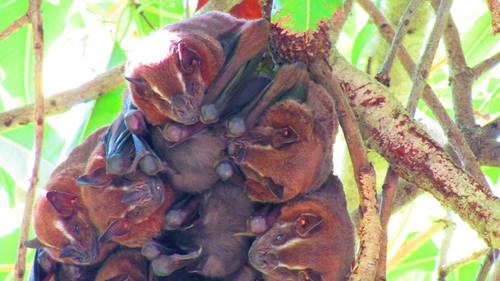
Great Fruit-eating Bat
Artibeus lituratus

Greater Spear-nosed Bat
Phyllostomus hastatus

Common Big-eared Bat
Micronycteris microtis
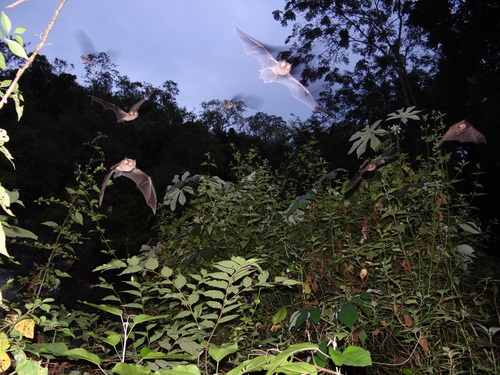
Mesoamerican Common Mustached Bat
Pteronotus mesoamericanus

chestnut short-tailed bat
Carollia castanea

White-throated Round-eared Bat
Lophostoma silvicola
Global Distribution
Warmer areas are where this animal is recorded most often.
Parks Where Found
| # | Park | Country | Daily sighting probability |
|---|---|---|---|
| 1 | Santa Rosa National Park | 🇨🇷 Costa Rica | |
| 2 | Caroni Swamp | 🇹🇹 Trinidad and Tobago | |
| 3 | El Impenetrable National Park | 🇦🇷 Argentina | |
| 4 | Cabo Blanco Absolute Nature Reserve | 🇨🇷 Costa Rica | |
| 5 | Main Ridge Forest Reserve | 🇹🇹 Trinidad and Tobago | |
| 6 | Palo Verde National Park | 🇨🇷 Costa Rica | |
| 7 | Parque Estadual Encontro das Águas | 🇧🇷 Brazil | |
| 8 | Celestún Biosphere Reserve | 🇲🇽 Mexico | |
| 9 | Tijuca National Park | 🇧🇷 Brazil | |
| 10 | Soberanía National Park | 🇵🇦 Panama |