


Great Eared-Nightjar
Lyncornis macrotis
- KingdomAnimalia (Animals)
- PhylumChordata (Chordates)
- ClassAves (Birds)
- OrderCaprimulgiformes (Nightjars and Allies)
- FamilyCaprimulgidae (Nightjars and Allies)
- GenusLyncornis (Eared Nightjars)
- SpeciesLyncornis macrotis (Great Eared-Nightjar)
About the Great Eared-Nightjar
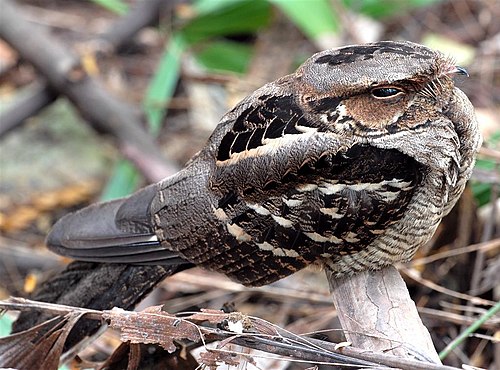
The great eared nightjar (Lyncornis macrotis) is a species of nightjar in the genus Lyncornis. It is found in southwest India and in parts of Southeast Asia. This very large nightjar has long barred wings, a barred tail and long ear-tufts which are often recumbent. It has a white throat band but has no white on its wings or on its tail.
The great eared nightjar was formally described in 1831 by the Irish zoologist Nicholas Aylward Vigors based on a sample collected in the neighbourhood of Manila in the Philippines. Vigors coined the binomial name Caprimulgus macrotis. The great eared nightjar was formerly placed in the genus Eurostopodus. It and the closely related Malaysian eared nightjar were moved to the resurrected genus Lyncornis based on the results of a molecular phylogenetic study published in 2010 that found large genetic differences between the great eared nightjar and other species in Eurostopodus. The genus name Lyncornis combines the Ancient Greek λύγξ /lunx/ (meaning "lynx") with ὄρνις /ornis/, meaning "bird". The specific epithet macrotis is from the Ancient Greek μακρὦτης /makrōtēs/, meaning "long-eared" (from μακρός /makros/ meaning "long" and οὖς /ous/... Wikipedia →
Closest Relatives at Tangkoko Nature Reserve

Global Distribution
Where this species is recorded worldwide. Restricted to human observations from 2019 onwards — the same kind of record and the same period the probabilities on this page are built from, so collar-tracking studies, camera-trap arrays and museum specimens are excluded. Around Santa Rosa that removes 5,924 GPS fixes from a handful of tagged jaguars.
where this species is recorded (GBIF density — it tracks where observers go, not how likely a sighting is) · parks where it occurs — tap a pin for the sighting probability there
Parks Where Found
| # | Park | Country | Daily sighting probability |
|---|---|---|---|
| 1 | Cat Tien National Park | 🇻🇳 Vietnam | |
| 2 | Khao Yai National Park | 🇹🇭 Thailand | |
| 3 | Tangkoko Nature Reserve | 🇮🇩 Indonesia | |
| 4 | Periyar National Park | 🇮🇳 India | |
| 5 | Kaeng Krachan National Park | 🇹🇭 Thailand | |
| 6 | Khao Sok National Park | 🇹🇭 Thailand | |
| 7 | Taman Negara National Park | 🇲🇾 Malaysia | |
| 8 | Doi Inthanon National Park | 🇹🇭 Thailand |
Quick answers
What are the chances of seeing a Great Eared-Nightjar in Tangkoko Nature Reserve?
About 10% of wildlife watchers report a Great Eared-Nightjar sighting in Tangkoko Nature Reserve, based on 137 verified sightings from GBIF citizen-science data.
When is the best time to see Great Eared-Nightjar in Tangkoko Nature Reserve?
April has the highest sighting rate for Great Eared-Nightjar in Tangkoko Nature Reserve in our monthly data.