


Black-and-red Broadbill
Cymbirhynchus macrorhynchos
- KingdomAnimalia (Animals)
- PhylumChordata (Chordates)
- ClassAves (Birds)
- OrderPasseriformes (Perching Birds)
- FamilyEurylaimidae (Asian and Grauer's Broadbills)
- GenusCymbirhynchus
- SpeciesCymbirhynchus macrorhynchos (Black-and-red Broadbill)
About the Black-and-red Broadbill
The black-and-red broadbill (Cymbirhynchus macrorhynchos) is a species of bird in the typical broadbill family, Eurylaimidae. It is the only species in the genus Cymbirhynchus. A large, distinctive bird, it has maroon underparts, black upperparts, a maroon neck-band, and white bars on the wings. It also has a large, two-colored, blue-and-yellow bill. The species shows slight sexual dimorphism, with females being smaller than males. No other bird in its range resembles it, though the black-and-yellow broadbill has a similar call.
The species is found in Brunei, Cambodia, Indonesia, Laos, Malaysia, Myanmar, Singapore, Thailand, and Vietnam. Inhabiting lowland riparian forest throughout its range, it can also adapt quite well to disturbed habitat, such as secondary forest growth and degraded habitat near rivers. The black-and-red broadbill is mainly insectivorous, supplementing its diet with aquatic creatures such as mollusks, snails, fish, and crustaceans. It also takes leaves and seeds incidentally.
Breeding takes place during the dry season throughout its range, with the nest being a large, conspicuous structure that usually hangs over water. Nests are built by both sexes, out of creepers, fungal hyphae, moss, and other plant matter. Eggs are laid in clutches of two or three, occasionally with a fourth runt egg, and incubated by both parents. The black-and-red broadbill is evaluated as a least-concern species by the International Union for Conservation of Nature due to its large range and the lack of a severe decrease in its global population. However, the species has experienced declines in several parts of its range, and may face threats due to deforestation, trapping for the songbird trade, and hunting. Wikipedia →
Closest Relatives at Tanjung Puting National Park

Black-and-yellow Broadbill
Eurylaimus ochromalus

Dusky Broadbill
Corydon sumatranus

Malaysian Pied-Fantail
Rhipidura javanica

Olive-winged Bulbul
Pycnonotus plumosus
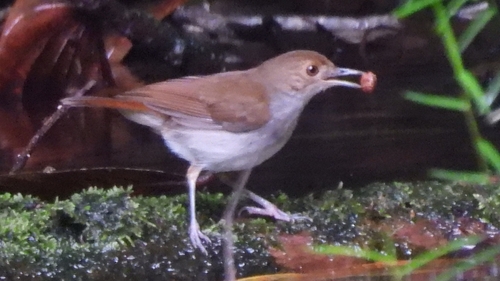
White-chested Babbler
Trichastoma rostratum

Little Spiderhunter
Arachnothera longirostra

Slender-billed Crow
Corvus enca

Van Hasselt's Sunbird
Leptocoma brasiliana

Malaysian Blue-Flycatcher
Cyornis turcosus

Greater Racket-tailed Drongo
Dicrurus paradiseus

Black-winged Flycatcher-shrike
Hemipus hirundinaceus

Green Iora
Aegithina viridissima
Global Distribution
Where this species is recorded worldwide. Restricted to human observations from 2019 onwards — the same kind of record and the same period the probabilities on this page are built from, so collar-tracking studies, camera-trap arrays and museum specimens are excluded. Around Santa Rosa that removes 5,924 GPS fixes from a handful of tagged jaguars.
where this species is recorded (GBIF density — it tracks where observers go, not how likely a sighting is) · parks where it occurs — tap a pin for the sighting probability there
Parks Where Found
| # | Park | Country | Daily sighting probability |
|---|---|---|---|
| 1 | Tanjung Puting National Park | 🇮🇩 Indonesia | |
| 2 | Kinabatangan Wildlife Sanctuary | 🇲🇾 Malaysia | |
| 3 | Cat Tien National Park | 🇻🇳 Vietnam | |
| 4 | Taman Negara National Park | 🇲🇾 Malaysia | |
| 5 | Way Kambas National Park | 🇮🇩 Indonesia | |
| 6 | Sepilok | 🇲🇾 Malaysia | |
| 7 | Danum Valley Conservation Area | 🇲🇾 Malaysia | |
| 8 | Kaeng Krachan National Park | 🇹🇭 Thailand | |
| 9 | Khao Sok National Park | 🇹🇭 Thailand | |
| 10 | Gunung Leuser National Park | 🇮🇩 Indonesia | |
| 11 | Kinabalu Park | 🇲🇾 Malaysia | |
| 12 | Khao Luang National Park | 🇹🇭 Thailand | |
| 13 | Kerinci Seblat National Park | 🇮🇩 Indonesia |
Quick answers
What are the chances of seeing a Black-and-red Broadbill in Tanjung Puting National Park?
About 60% of wildlife watchers report a Black-and-red Broadbill sighting in Tanjung Puting National Park, based on 77 verified sightings from GBIF citizen-science data.
When is the best time to see Black-and-red Broadbill in Tanjung Puting National Park?
May has the highest sighting rate for Black-and-red Broadbill in Tanjung Puting National Park in our monthly data.