


Gray-chinned Minivet
Pericrocotus solaris
- KingdomAnimalia (Animals)
- PhylumChordata (Chordates)
- ClassAves (Birds)
- OrderPasseriformes (Perching Birds)
- FamilyCampephagidae (Cuckooshrikes)
- GenusPericrocotus (Minivets)
- SpeciesPericrocotus solaris (Gray-chinned Minivet)
About the Gray-chinned Minivet
The grey-chinned minivet (Pericrocotus solaris) is a species of bird in the family Campephagidae. It is found from the Himalayas to China, Taiwan and Southeast Asia. Its natural habitat is forests about 1,000–2,000 m (3,300–6,600 ft) in elevation. The International Union for Conservation of Nature (IUCN) has assessed it as a least-concern species.
This species was described from Darjeeling by Edward Blyth in 1846. The IOC World Bird List recognises eight subspecies: Pericrocotus solaris solaris found in the Himalayas and northern and western Myanmar; P. s. rubrolimbatus in eastern Myanmar and northern Thailand; P. s. montpellieri in southern China; P. s. griseogularis in southeastern China, Taiwan, northeastern Laos and northern Vietnam; P. s. deignani in southern Laos and central Vietnam; P. s. nassovicus in eastern Thailand and southern Cambodia; P. s. montanus in western Malaysia and Sumatra; and P. s. cinereigula in Borneo. The Handbook of the Birds of the World considers that montanus and cinereigula form a separate species.
The grey-chinned minivet is 17–19 cm (6.7–7.5 in) long and weighs 11–17 g (0.39–0.60 oz). It is sexually dimorphic. The adult... Wikipedia →
Closest Relatives at Tanjung Puting National Park

Fiery Minivet
Pericrocotus igneus

Scarlet Minivet
Pericrocotus speciosus

Malaysian Pied-Fantail
Rhipidura javanica

Black-and-red Broadbill
Cymbirhynchus macrorhynchos

Olive-winged Bulbul
Pycnonotus plumosus
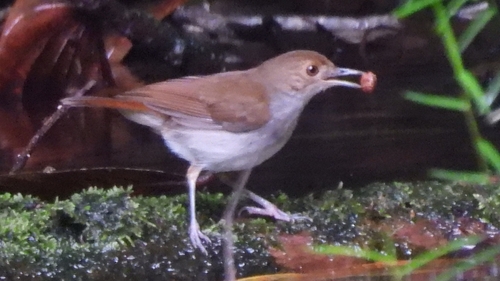
White-chested Babbler
Trichastoma rostratum

Little Spiderhunter
Arachnothera longirostra

Slender-billed Crow
Corvus enca

Van Hasselt's Sunbird
Leptocoma brasiliana

Malaysian Blue-Flycatcher
Cyornis turcosus

Greater Racket-tailed Drongo
Dicrurus paradiseus

Black-winged Flycatcher-shrike
Hemipus hirundinaceus
Global Distribution
Where this species is recorded worldwide. Restricted to human observations from 2019 onwards — the same kind of record and the same period the probabilities on this page are built from, so collar-tracking studies, camera-trap arrays and museum specimens are excluded. Around Santa Rosa that removes 5,924 GPS fixes from a handful of tagged jaguars.
where this species is recorded (GBIF density — it tracks where observers go, not how likely a sighting is) · parks where it occurs — tap a pin for the sighting probability there
Parks Where Found
| # | Park | Country | Daily sighting probability |
|---|---|---|---|
| 1 | Kinabalu Park | 🇲🇾 Malaysia | |
| 2 | Taroko National Park | 🇹🇼 Taiwan | |
| 3 | Kerinci Seblat National Park | 🇮🇩 Indonesia | |
| 4 | Doi Inthanon National Park | 🇹🇭 Thailand | |
| 5 | Royal Manas National Park | 🇧🇹 Bhutan | |
| 6 | Namdapha National Park | 🇮🇳 India | |
| 7 | Kaeng Krachan National Park | 🇹🇭 Thailand | |
| 8 | Khangchendzonga National Park | 🇮🇳 India | |
| 9 | Tanjung Puting National Park | 🇮🇩 Indonesia | |
| 10 | Jiuzhaigou National Park | 🇨🇳 China | |
| 11 | Langtang National Park | 🇳🇵 Nepal | |
| 12 | Taman Negara National Park | 🇲🇾 Malaysia | |
| 13 | Sepilok | 🇲🇾 Malaysia | |
| 14 | Manas National Park | 🇮🇳 India |