
Siberian Blue Robin
Luscinia cyane
- KingdomAnimalia (Animals)
- PhylumChordata (Chordates)
- ClassAves (Birds)
- OrderPasseriformes (Perching Birds)
- FamilyMuscicapidae (Old World Flycatchers, Robins, and Chats)
- GenusLuscinia (Nightingales and Allies)
- SpeciesLuscinia cyane (Siberian Blue Robin)
About the Siberian Blue Robin
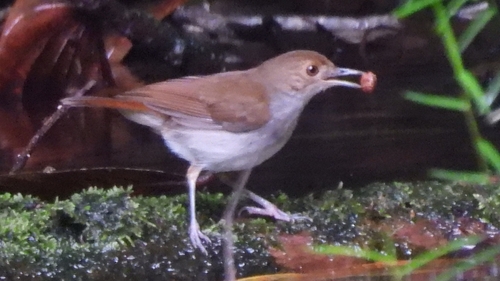
The Siberian blue robin (Larvivora cyane) is a small passerine bird that was formerly classified as a member of the thrush family, Turdidae, but is now more generally considered to belong to the Old World flycatcher family, Muscicapidae. It and similar small European species are often called chats. Recent research suggests that this species and some other East Asian members of Luscinia should be classified in a new genus, together with the Japanese and Ryūkyū robins. The genus name Larvivora comes from the Neo-Latin larva meaning caterpillar and -vorus meaning eating (vorace to devour), and cyane is Latin for "dark-blue".
This bird is a migratory insectivorous species breeding in the eastern Palearctic from Siberia and northern Mongolia, northeastern China, Korea and across to Japan. It winters in southern and south-eastern Asia and Indonesia.
The breeding habitat is coniferous forest with dense understory, often beside rivers or at woodland edges. It feeds on the ground but is very 'skulking'. In winter, this bird also tends to stay in dense vegetation. This species is a very rare vagrant to Europe, and has vagrant status even as far east as Pakistan. The Siberian blue robin was previously placed in the genus Luscinia. A large molecular phylogenetic study published in 2010 found that Luscinia was not monophyletic. The genus was therefore split and several species including the Siberian blue robin were moved to the reinstated genus Larvivora. Wikipedia →
Closest Relatives at Tanjung Puting National Park

Malaysian Blue-Flycatcher
Cyornis turcosus

Oriental Magpie-Robin
Copsychus saularis

Grey-chested Jungle Flycatcher
Rhinomyias umbratilis

Mangrove Blue-Flycatcher
Cyornis rufigastra

Bornean Blue-Flycatcher
Cyornis superbus

Rufous-chested Flycatcher
Ficedula dumetoria

Malaysian Pied-Fantail
Rhipidura javanica

Black-and-red Broadbill
Cymbirhynchus macrorhynchos

Olive-winged Bulbul
Pycnonotus plumosus
White-chested Babbler
Trichastoma rostratum

Little Spiderhunter
Arachnothera longirostra

Slender-billed Crow
Corvus enca
Global Distribution
Where this species is recorded worldwide. Restricted to human observations from 2019 onwards — the same kind of record and the same period the probabilities on this page are built from, so collar-tracking studies, camera-trap arrays and museum specimens are excluded. Around Santa Rosa that removes 5,924 GPS fixes from a handful of tagged jaguars.
where this species is recorded (GBIF density — it tracks where observers go, not how likely a sighting is) · parks where it occurs — tap a pin for the sighting probability there
Parks Where Found
| # | Park | Country | Daily sighting probability |
|---|---|---|---|
| 1 | Cat Tien National Park | 🇻🇳 Vietnam | |
| 2 | Kaeng Krachan National Park | 🇹🇭 Thailand | |
| 3 | Khao Luang National Park | 🇹🇭 Thailand | |
| 4 | Doi Inthanon National Park | 🇹🇭 Thailand | |
| 5 | Khao Sok National Park | 🇹🇭 Thailand | |
| 6 | Nikko National Park | 🇯🇵 Japan | |
| 7 | Way Kambas National Park | 🇮🇩 Indonesia | |
| 8 | Danum Valley Conservation Area | 🇲🇾 Malaysia | |
| 9 | Khao Yai National Park | 🇹🇭 Thailand | |
| 10 | Kinabalu Park | 🇲🇾 Malaysia | |
| 11 | Taman Negara National Park | 🇲🇾 Malaysia | |
| 12 | Tanjung Puting National Park | 🇮🇩 Indonesia | |
| 13 | Cuc Phuong National Park | 🇻🇳 Vietnam | |
| 14 | Kerinci Seblat National Park | 🇮🇩 Indonesia | |
| 15 | Gobi Gurvansaikhan National Park | 🇲🇳 Mongolia | |
| 16 | Kinabatangan Wildlife Sanctuary | 🇲🇾 Malaysia | |
| 17 | Sepilok | 🇲🇾 Malaysia |