



Spot-breasted Oriole
Icterus pectoralis
Silhouette: Matt Wilkins · PhyloPic
- KingdomAnimalia (Animals)
- PhylumChordata (Chordates)
- ClassAves (Birds)
- OrderPasseriformes (Perching Birds)
- FamilyIcteridae (New World Blackbirds and Orioles)
- GenusIcterus (New World Orioles)
- SpeciesIcterus pectoralis (Spot-breasted Oriole)
About the Spot-breasted Oriole
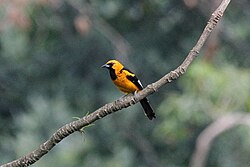
The spot-breasted oriole (Icterus pectoralis) is a species of bird in the family Icteridae, the oropendolas, New World orioles, and New World blackbirds. It is found from Mexico to Costa Rica. It also has an introduced population in southern Florida.
The spot-breasted oriole was formally described in 1829 with the binomial Psarocolius pectoralis. The spot-breasted oriole has these four subspecies: I. p. carolynae Dickerman, 1981 I. p. pectoralis (Wagler, 1829) I. p. guttulatus Lafresnaye, 1844
I. p. espinachi Ridgway, 1882 The spot-breasted oriole is about 21 cm (8.3 in) long. Its wing chord is 8.8 to 11.4 cm (3.5 to 4.5 in), its tail 8.5 to 11.2 cm (3.3 to 4.4 in), its culmen 1.9 to 2.4 cm (0.75 to 0.94 in), and its tarsus 2.6–3 cm (1.0–1.2 in). Males weigh an average of about 53 g (1.9 oz) and females about 45 g (1.6 oz). The sexes have the essentially same plumage though females are duller than males. Adults of the nominate subspecies I. p. pectoralis have a mostly deep orange head and nape. They have a black "mask", throat, "bib" on the upper breast, mantle, and back. Their rump is orange. Their wings are mostly black with orange... Wikipedia →
Recent sightings of Spot-breasted Oriole in Tenorio Volcano National Park
LIVEiNaturalistClosest Relatives at Tenorio Volcano National Park

 Baltimore Oriole
Icterus galbula

Black-cowled Oriole
Icterus prosthemelas

Orchard Oriole
Icterus spurius

Streak-backed Oriole
Icterus pustulatus

 Montezuma Oropendola
Psarocolius montezuma

Melodious Blackbird
Dives dives

 Great-tailed Grackle
Quiscalus mexicanus

Chestnut-headed Oropendola
Psarocolius wagleri

 Bronzed Cowbird
Molothrus aeneus

Eastern Meadowlark
Sturnella magna

Giant Cowbird
Molothrus oryzivorus

Scarlet-rumped Cacique
Cacicus uropygialis
Global Distribution
Warmer areas are where this animal is recorded most often.
Parks Where Found
| # | Park | Country | Daily sighting probability |
|---|---|---|---|
| 1 | Masaya Volcano National Park | 🇳🇮 Nicaragua | |
| 2 | El Triunfo | 🇲🇽 Mexico | |
| 3 | Celaque National Park | 🇭🇳 Honduras | |
| 4 | Lago de Yojoa | 🇭🇳 Honduras | |
| 5 | Palo Verde National Park | 🇨🇷 Costa Rica | |
| 6 | Cerro Azul Meámbar National Park | 🇭🇳 Honduras | |
| 7 | La Tigra National Park | 🇭🇳 Honduras | |
| 8 | Pico Bonito National Park | 🇭🇳 Honduras | |
| 9 | Santa Rosa National Park | 🇨🇷 Costa Rica | |
| 10 | Las Baulas Marine National Park | 🇨🇷 Costa Rica | |
| 11 | Everglades National Park | 🇺🇸 United States | |
| 12 | Carara National Park | 🇨🇷 Costa Rica | |
| 13 | Ostional Wildlife Refuge | 🇨🇷 Costa Rica | |
| 14 | Cusuco National Park | 🇭🇳 Honduras | |
| 15 | Cabo Blanco Absolute Nature Reserve | 🇨🇷 Costa Rica | |
| 16 | Tenorio Volcano National Park | 🇨🇷 Costa Rica |