
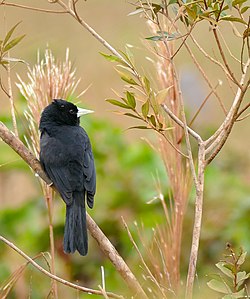

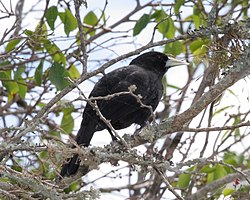

Solitary Black Cacique
Cacicus solitarius
Silhouette: Sheatherius · PhyloPic
- KingdomAnimalia (Animals)
- PhylumChordata (Chordates)
- ClassAves (Birds)
- OrderPasseriformes (Perching Birds)
- FamilyIcteridae (New World Blackbirds and Orioles)
- GenusCacicus (Typical Caciques)
- SpeciesCacicus solitarius (Solitary Black Cacique)
About the Solitary Black Cacique
The solitary cacique or solitary black cacique (Cacicus solitarius) is a species of bird in the family Icteridae. It is found in Argentina, Bolivia, Brazil, Colombia, Ecuador, Paraguay, Peru, Uruguay, and Venezuela. Its natural habitats are subtropical or tropical moist lowland forests, subtropical or tropical swamps, and heavily degraded former forest. It is a fairly common bird with a very extensive range so the IUCN has rated it as a "species of least concern".
The male solitary cacique has a length of about 27 cm (10.6 in) and the female 23 cm (9.1 in). It differs from all other entirely black birds with dark irises within its range, by having a large white, chisel-shaped, sharply-pointed beak. It could be confused with the Ecuadorian cacique (Cacicus sclateri), but that is smaller and has a restricted range, or the yellow-billed cacique (Amblycercus holosericeus), but that is not found east of the Andes. It has a range of different vocalizations which are mostly delivered at a measured pace but are sometimes interrupted by gurgles and growls.
The solitary cacique has a very wide distribution in Amazonia. Its range extends southwards... Wikipedia →
Recent sightings of Solitary Black Cacique in Amacayacu National Natural Park
LIVEiNaturalistClosest Relatives at Amacayacu National Natural Park

 Yellow-rumped Cacique
Cacicus cela

Red-rumped Cacique
Cacicus haemorrhous

Russet-backed Oropendola
Psarocolius angustifrons

Band-tailed Oropendola
Ocyalus latirostris

 Orange-backed Oriole
Icterus icterus

Yellow-hooded Blackbird
Chrysomus icterocephalus

 Giant Cowbird
Molothrus oryzivorus

Epaulet Oriole
Icterus cayanensis

Casqued Cacique
Psarocolius oseryi

Crested Oropendola
Psarocolius decumanus

Red-breasted Blackbird
Sturnella militaris

Oriole Blackbird
Gymnomystax mexicanus
Global Distribution
Warmer areas are where this animal is recorded most often.
Parks Where Found
| # | Park | Country | Daily sighting probability |
|---|---|---|---|
| 1 | El Impenetrable National Park | 🇦🇷 Argentina | |
| 2 | Iberá National Park | 🇦🇷 Argentina | |
| 3 | Parque Estadual Encontro das Águas | 🇧🇷 Brazil | |
| 4 | Cuyabeno Wildlife Reserve | 🇪🇨 Ecuador | |
| 5 | Yasuní National Park | 🇪🇨 Ecuador | |
| 6 | Amacayacu National Natural Park | 🇨🇴 Colombia | |
| 7 | Tambopata National Reserve | 🇵🇪 Peru | |
| 8 | Manu National Park | 🇵🇪 Peru | |
| 9 | El Palmar National Park | 🇦🇷 Argentina | |
| 10 | Cordillera Azul National Park | 🇵🇪 Peru | |
| 11 | Amboró National Park | 🇧🇴 Bolivia | |
| 12 | Madidi National Park | 🇧🇴 Bolivia | |
| 13 | Sierra de la Macarena National Park | 🇨🇴 Colombia | |
| 14 | Chingaza National Natural Park | 🇨🇴 Colombia | |
| 15 | Chapada Diamantina National Park | 🇧🇷 Brazil | |
| 16 | Anavilhanas National Park | 🇧🇷 Brazil | |
| 17 | Iguaçu National Park | 🇧🇷 Brazil | |
| 18 | Puracé National Natural Park | 🇨🇴 Colombia | |
| 19 | Iguazú National Park | 🇦🇷 Argentina | |
| 20 | Podocarpus National Park | 🇪🇨 Ecuador |
Quick answers
What are the chances of seeing a Solitary Black Cacique in Amacayacu National Natural Park?
About 10% of wildlife watchers report a Solitary Black Cacique sighting in Amacayacu National Natural Park, based on 47 verified sightings from GBIF citizen-science data.
When is the best time to see Solitary Black Cacique in Amacayacu National Natural Park?
August has the highest sighting rate for Solitary Black Cacique in Amacayacu National Natural Park in our monthly data.