

Variable Hawk
Buteo polyosoma
Silhouette: Lauren Anderson · PhyloPic
- KingdomAnimalia (Animals)
- PhylumChordata (Chordates)
- ClassAves (Birds)
- OrderAccipitriformes (Hawks, Eagles, Kites, and Allies)
- FamilyAccipitridae (Hawks, Eagles, and Kites)
- GenusButeo (Buteos)
- SpeciesButeo polyosoma (Variable Hawk)
About the Variable Hawk
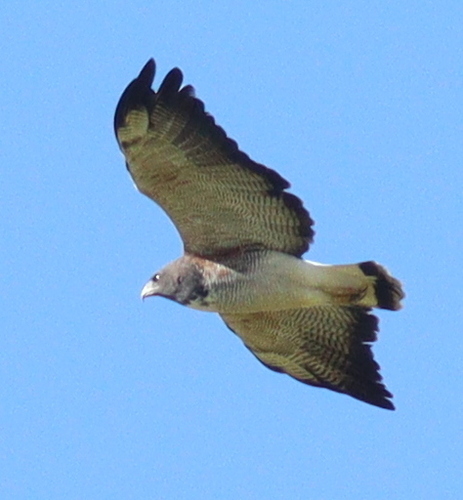
The variable hawk (Geranoaetus polyosoma) is a polymorphic species of bird of prey in the family Accipitridae. It is widespread and often common in open habitats in western and southern South America, including the Falkland Islands. Its taxonomy is disputed, with some splitting it into the widespread red-backed hawk (G. polyosoma) and the Puna hawk or Gurney's hawk (G. poecilochrous) of the central and north Andean highlands, but the differences between the two are unclear. Most recent authorities have supported the lumping together of the two hawks although the issue still is controversial. On the contrary, the rare taxon from the Juan Fernández Islands is relatively distinctive, and possibly worthy of species recognition as the Juan Fernández hawk (B. exsul). In this article and most current accounts, the three races are regarded as subspecies.
The name variable hawk is fully deserved, as both sexes occur in several morphs. Adults of all have a white tail with a contrasting black subterminal band and grey wings barred dark (in flight from below, the remiges appear whitish with fine barring and a broad black tip). The remaining plumage varies from very dark grey... Wikipedia →
Recent sightings of Variable Hawk in Amboró National Park
LIVEiNaturalistClosest Relatives at Amboró National Park

 Short-tailed Hawk
Buteo brachyurus
White-tailed Hawk
Buteo albicaudatus

Zone-tailed Hawk
Buteo albonotatus

Gray-lined Hawk
Buteo nitidus

 Roadside Hawk
Rupornis magnirostris

 White Hawk
Leucopternis albicollis

Black-chested Buzzard-Eagle
Geranoaetus melanoleucus

 American Swallow-tailed Kite
Elanoides forficatus

 Plumbeous Kite
Ictinia plumbea

 White-tailed Kite
Elanus leucurus

Savanna Hawk
Buteogallus meridionalis

Solitary Eagle
Harpyhaliaetus solitarius
Global Distribution
Warmer areas are where this animal is recorded most often.
Parks Where Found
| # | Park | Country | Daily sighting probability |
|---|---|---|---|
| 1 | Lauca National Park | 🇨🇱 Chile | |
| 2 | Península Valdés | 🇦🇷 Argentina | |
| 3 | Cajas National Park | 🇪🇨 Ecuador | |
| 4 | Huascarán National Park | 🇵🇪 Peru | |
| 5 | Vicente Pérez Rosales National Park | 🇨🇱 Chile | |
| 6 | Nahuel Huapi National Park | 🇦🇷 Argentina | |
| 7 | Amboró National Park | 🇧🇴 Bolivia | |
| 8 | Paracas National Reserve | 🇵🇪 Peru | |
| 9 | Podocarpus National Park | 🇪🇨 Ecuador | |
| 10 | Puracé National Natural Park | 🇨🇴 Colombia | |
| 11 | Madidi National Park | 🇧🇴 Bolivia | |
| 12 | Tierra del Fuego National Park | 🇦🇷 Argentina | |
| 13 | Torres del Paine National Park | 🇨🇱 Chile | |
| 14 | Los Nevados National Natural Park | 🇨🇴 Colombia | |
| 15 | Machalilla National Park | 🇪🇨 Ecuador | |
| 16 | Cordillera Azul National Park | 🇵🇪 Peru |
Quick answers
What are the chances of seeing a Variable Hawk in Amboró National Park?
Under 5% of wildlife watchers report a Variable Hawk sighting in Amboró National Park, based on 7 verified sightings from GBIF citizen-science data.
When is the best time to see Variable Hawk in Amboró National Park?
May has the highest sighting rate for Variable Hawk in Amboró National Park in our monthly data.