


Lesser Crested Tern
Thalasseus bengalensis
- KingdomAnimalia (Animals)
- PhylumChordata (Chordates)
- ClassAves (Birds)
- OrderCharadriiformes (Shorebirds and Allies)
- FamilyLaridae (Gulls, Terns, and Skimmers)
- GenusThalasseus (Crested Terns)
- SpeciesThalasseus bengalensis (Lesser Crested Tern)
About the Lesser Crested Tern
The lesser crested tern (Thalasseus bengalensis) is a tern in the family Laridae. The genus name is from Ancient Greek Thalasseus, "fisherman" from thalassa, "sea". The specific bengalensis means "of Bengal", the type locality, historically referring to Bangladesh and part of Northeast India.
It breeds in subtropical coastal parts of the world mainly from the Red Sea across the Indian Ocean to the western Pacific, and Australia, with a significant population on the southern coast of the Mediterranean on two islands off the Libyan coast. It is an occasional vagrant to Europe, where it has been known to breed in pure and mixed (with Sandwich tern) pairs. The Australian birds are probably sedentary, but other populations are migratory, wintering south to South Africa.
This bird has three geographical subspecies, differing mainly in size and minor plumage details: T. b. emigratus (Neumann, 1934): breeding in the Mediterranean on islands off the coast of Libya, wintering West Africa. Pale grey above (only marginally darker than Sandwich tern); slightly larger.
T. b. bengalensis (Lesson, 1831): northern Indian Ocean including the Red Sea... Wikipedia →
Closest Relatives at Bako National Park

Crested Tern
Thalasseus bergii

Gull-billed Tern
Gelochelidon nilotica

Little Tern
Sternula albifrons

Black-naped Tern
Sterna sumatrana

Whiskered Tern
Chlidonias hybrida

Bridled Tern
Onychoprion anaethetus
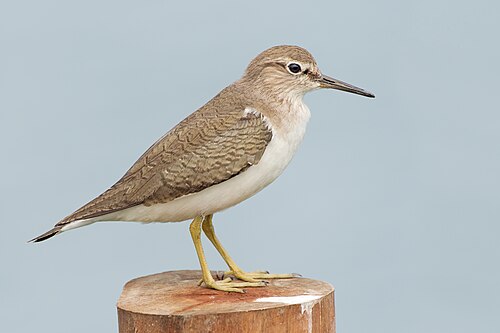
Common Sandpiper
Actitis hypoleucos

Whimbrel
Numenius phaeopus

Terek Sandpiper
Xenus cinereus

Eurasian Curlew
Numenius arquata

Far Eastern Curlew
Numenius madagascariensis

Common Greenshank
Tringa nebularia
Global Distribution
Where this species is recorded worldwide. Restricted to human observations from 2019 onwards — the same kind of record and the same period the probabilities on this page are built from, so collar-tracking studies, camera-trap arrays and museum specimens are excluded. Around Santa Rosa that removes 5,924 GPS fixes from a handful of tagged jaguars.
where this species is recorded (GBIF density — it tracks where observers go, not how likely a sighting is) · parks where it occurs — tap a pin for the sighting probability there
Parks Where Found
| # | Park | Country | Daily sighting probability |
|---|---|---|---|
| 1 | Ningaloo Marine Park | 🇦🇺 Australia | |
| 2 | Cape Range | 🇦🇺 Australia | |
| 3 | Tsavo East National Park | 🇰🇪 Kenya | |
| 4 | iSimangaliso Wetland Park | 🇿🇦 South Africa | |
| 5 | Yala National Park | 🇱🇰 Sri Lanka | |
| 6 | Bali Barat National Park | 🇮🇩 Indonesia | |
| 7 | Daintree National Park | 🇦🇺 Australia | |
| 8 | Raja Ampat | 🇮🇩 Indonesia | |
| 9 | Lake Nakuru National Park | 🇰🇪 Kenya | |
| 10 | Bako National Park | 🇲🇾 Malaysia | |
| 11 | Noosa National Park | 🇦🇺 Australia | |
| 12 | Wilpattu National Park | 🇱🇰 Sri Lanka | |
| 13 | Ankarafantsika National Park | 🇲🇬 Madagascar | |
| 14 | Kerinci Seblat National Park | 🇮🇩 Indonesia | |
| 15 | Ranomafana National Park | 🇲🇬 Madagascar | |
| 16 | Doñana National Park | 🇪🇸 Spain |