
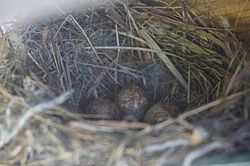


Blyth's Reed Warbler
Acrocephalus dumetorum
Silhouette: Yves Hoebeke · PhyloPic
- KingdomAnimalia (Animals)
- PhylumChordata (Chordates)
- ClassAves (Birds)
- OrderPasseriformes (Perching Birds)
- FamilyAcrocephalidae (Reed Warblers and Allies)
- GenusAcrocephalus (Reed Warblers)
- SpeciesAcrocephalus dumetorum (Blyth's Reed Warbler)
About the Blyth's Reed Warbler
Blyth's reed warbler (Acrocephalus dumetorum) is a species of reed warbler belonging to the family Acrocephalidae, which also includes the tree warblers. Blyth's reed warbler breeds across the Palearctic zoogeographical region and winters in South Asia. The species has been expanding its range westwards in Europe.
Blyth's reed warbler was first formally described in 1849 by the English zoologist Edward Blyth with its type locality given as India. It is classified in the reed warbler genus Acrocephalus which was formerly included in the polyphyletic family Sylviidae but is now included in the family Acrocephalidae.
Blyth's reed warbler is named in honour of Edward Blyth, its describer. The genus name Acrocephalus is from Ancient Greek akros, "highest", and kephale, "head". It is possible that Naumann and Naumann thought akros meant "sharp-pointed". The specific dumetorum is from Latin dumetum, "thicket".
Blyth's reed warbler is between 12 and 14 cm (4.7 and 5.5 in) in length and weighs between 8 and 16 g (0.28 and 0.56 oz). It is a slim warbler with relatively short wings and a long bill. The plumage is rather plain with few distinguishing... Wikipedia →
Recent sightings of Blyth's Reed Warbler in Biebrza National Park
LIVEiNaturalistClosest Relatives at Biebrza National Park

 Sedge Warbler
Acrocephalus schoenobaenus

Great Reed-Warbler
Acrocephalus arundinaceus

Aquatic Warbler
Acrocephalus paludicola

Marsh Warbler
Acrocephalus palustris

 Eurasian Reed-Warbler
Acrocephalus scirpaceus

 Icterine Warbler
Hippolais icterina

 Booted Warbler
Iduna caligata

 European Starling
Sturnus vulgaris

 Hooded Crow
Corvus cornix

 Chaffinch
Fringilla coelebs

 Reed Bunting
Emberiza schoeniclus

 Yellowhammer
Emberiza citrinella
Global Distribution
Warmer areas are where this animal is recorded most often.